


Jump to winners | Jump to methodology
Future-ready learning
Not a single element defines what makes a top school, and that’s also why The Educator’s 5-Star Best Schools 2025 are so special. They are a collection of schools that incorporate innovation, diversity, resources, community and culture to deliver the best experience possible for students.
“It’s not just one thing – it’s a mix of elements that all come together,” says Dr James Bedford, education specialist – artificial intelligence at UNSW College.
At the core, a top school delivers standout academic performance in NAPLAN tests and senior exams such as the HSC or VCE. “But honestly, it’s more than raw scores. What I find really interesting is this idea of focusing on the whole student,” adds Bedford. “A top school won’t just have them cramming for exams; they offer all sorts of extracurricular activities like robotics, arts programs and things that build character, resilience, leadership and creativity. Above all, a top school is a welcoming space where everyone aims high and support systems make sure no one falls through the cracks. It’s that blend of strong academics, solid resources, diverse opportunities and a caring culture that builds belonging, which really defines a top school.”
School leaders, administrators and education professionals were invited to complete an extensive online survey, providing quantitative and qualitative data that was assessed against the core pillars of educational excellence, such as innovative extracurricular programs, technology in learning and holistic student development. TE’s editorial and research team evaluated all entries with final selections based on a commitment to student success.
The ethos of comprehensive performance is echoed by Brett Salakas, education ambassador at HP. “Education is about developing the whole person and making that person successful in society, and society isn’t measured by how many people go to university. It is measured by so many other elements and variables, so a top school needs to be able to deliver a lot of different things.”
Analysis of technology trends
This is a key area for schools as they choose platforms and decide which systems to implement.
Salakas shares a real-life example of just how powerful tech can be when used appropriately. “AI can predict sentiment in the way that students are engaging with teachers. Even on Teams, by the way a child writes and responds to the teacher, AI can detect if that child is happy, unhappy or stressed,” he explains. “So instead of reacting when something goes wrong, they can say, ‘Why are they sad? Is there underground bullying happening?’ Proactive insights using AI detection is a technology that top schools will use to support the well-being of students.”
Here are the leading tech strategies TE’s 5-Star Best Schools 2025 have embraced.
1. Widespread integration of digital platforms and devices
-
BYOD and 1:1 device programs: Nearly all leading schools have adopted these initiatives, ensuring students have individual access to technology from early years through to senior secondary. Devices range from iPads in junior years to laptops and Surface Pros in senior years.
-
Cloud and learning management systems: Platforms like QLearn, Compass, Microsoft Teams, OneNote and Schoology are widely used, providing seamless access to curriculum, resources and communication for students, staff and parents. These systems support both in-class and remote learning, reflecting a shift to blended and flexible education models.
2. Pioneering use of AI
-
AI for learning and assessment: Schools such as St Andrew’s Anglican College have embedded AI tools for research, writing, formative assessment and feedback. Custom AI platforms (eg Larrakeyah Primary’s IntelliLearn and St Michael’s Grammar’s AI Network) offer personalised, ethical support, focusing on skill development rather than shortcuts.
-
AI in administration and support: AI avatars, digital assistants and automated systems (eg CodeTwo for email signatures and Pixevity for media consent) streamline operations and compliance, freeing up staff time for teaching and innovation.
3. Immersive and experiential learning environments
-
Virtual and augmented reality: Many schools have invested in VR/AR labs and devices. These tools are used across subjects, from science and humanities to creative arts, enabling immersive simulations, fieldwork and exploration of virtual worlds.
-
Specialist STEAM and makerspaces: Purpose-built facilities with 3D printers, robotics kits, CNC machines and laser cutters are common. These spaces support interdisciplinary, project-based learning and real-world problem-solving, fostering creativity and innovation.
4. Robotics, coding and automation
-
Robotics programs: Schools like Bishop Druitt and Ravenswood School for Girls have robust robotics offerings, often linked to national and international competitions. Programs span from LEGO Spike in early years to VEX and DJI RoboMasters in secondary, developing coding, engineering and systems thinking skills.
-
Automation and smart systems: RFID attendance, electronic queuing systems, and smart data platforms (eg Intellischools and custom dashboards) are being implemented for operational efficiency and digital safety.
5. Professional development and student agency
-
Staff upskilling: Leading schools invest in ongoing professional development, particularly around AI and digital pedagogy. Some have created specialist roles (eg AI Network Learning Specialist) and collaborate with universities and tech companies.
-
Student-led innovation: Initiatives like Lindisfarne’s Tech Innovators Forum and student co-design of digital content empower students to shape technology policy and practice, promoting digital citizenship and leadership.
6. Equity, accessibility and inclusion
-
Assistive technologies: Schools are deploying hearing loops, sound-field amplification, and AI-driven accessibility tools (eg NotebookLM for special needs) to ensure all students can participate fully.
-
Digital literacy and foundational skills: Programs like Typing Club, adaptive learning software and targeted PD for teachers in early years ensure foundational digital skills are developed from the outset.
Innovators and pioneers: who stands out?
Joseph Banks Secondary College (WA)
-
Space science simulation and mission control: Link up with the Western Australian Space Science Education Centre as students participate in simulated planetary missions using a custom-built Mars surface, complete with an inflatable dome, airlock and geological lab. Mission Control replicates professional space operations, enabling students to act as astronauts and mission controllers. Specialist tools include thermal sensors, seismic monitors and soil analysis kits.
Bishop Druitt College (NSW)
-
Immersive and AI-driven content: In Years 9–10 PDHPE, students use proprietary learner driver simulation software with a full driving simulator. ClassVR headsets (Years K–10) and HTC Vive Pro 2 systems (Years 6–12) enable immersive exploration of virtual worlds across subjects. DJI RoboMasters are used in Years 7–10 to teach robotics, coding and AI logic.
-
Australian top schools are not just adopting technology – they are shaping its use for deep, authentic learning.
-
Innovation is characterised by custom-built platforms, immersive environments and a deliberate focus on AI, robotics and real-world applications.
-
The most pioneering schools are those that extend their impact beyond their own students – through statewide programs, community partnerships and student-led initiatives.
Trends in extracurricular offerings
Developing and challenging students away from the typical classroom environment is an important marker of a leading school.
TE’s 5-Star Best Schools 2025 have the same aim but go about it in differing ways.
1. Breadth and diversity of activities
-
Comprehensive range: Top schools offer a vast array of extracurricular activities spanning sports, arts, music, STEM, service, leadership, wellbeing and special interest clubs. Most schools ensure there is “something for everyone,” catering to a wide range of student interests, talents and backgrounds.
-
Inclusivity: Many programs are intentionally designed to be inclusive, with activities for all abilities, ages and interests and with significant efforts to minimise or eliminate costs for participation, ensuring equity of access.
2. Innovation and pioneering approaches
-
Music and performing arts: Many schools offer extensive music and performing arts programs, with multiple ensembles, bands, choirs and opportunities for public performance.
-
E-sports and digital innovation: E-sports clubs and digital media production (eg podcasting, film clubs and AV crews) are emerging as innovative offerings, reflecting the changing interests and career pathways of students.
-
Unique clubs and programs: Schools are introducing novel clubs such as Dungeons & Dragons, drone racing, barista training, goat and cattle clubs and sustainability/eco clubs, demonstrating a willingness to innovate and respond to student interests.
3. Holistic programs
-
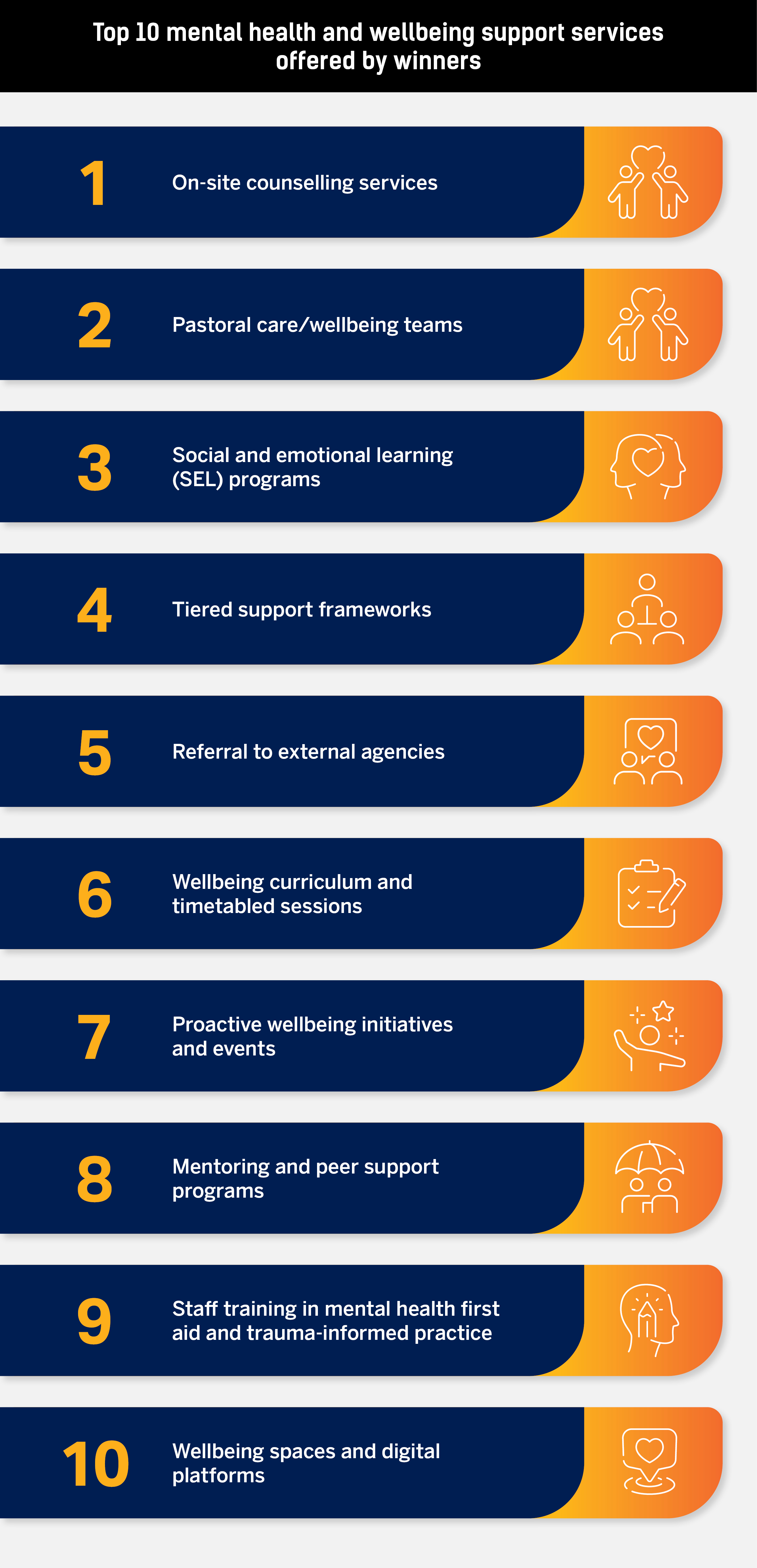
Wellbeing and social-emotional learning: Many schools embed wellbeing activities (eg yoga, mindfulness, gardening, breakfast clubs, and peer support) and offer free tutoring or homework support, recognising the importance of supporting the whole child.
-
Leadership and service: Leadership development and community service are core components, with programs like the Duke of Edinburgh Award, student representative councils and service learning initiatives. Some have culturally specific leadership and identity programs for Indigenous and multicultural students.
4. Integration with academic and career pathways
-
Academic enrichment: Debating, Model United Nations, academic competitions (eg Ethics Olympiad and da Vinci Decathlon) and extension clubs are common, supporting critical thinking and academic excellence.
-
Career and industry links: Some schools offer career pathway tours, university visits and industry-linked programs, giving students early exposure to future opportunities.
Schools leading and innovating in extracurriculars
Brisbane Grammar School (Qld)
-
STEAM cocurricular program, which provides hands-on learning opportunities in areas such as robotics, future problem solving, STEM racing, game design, astronomy, lapidary, makerspace, silversmithing and visual arts, including drawing and enterprise, printmaking, ceramics, painting and mixed media.
Lindisfarne Anglican Grammar School (NSW)
-
Germinate Records allows students to write, produce and distribute original music through the school’s own label – an exceptional opportunity for young artists and sound engineers.
-
For sports enthusiasts, the Matt Fydler Sports Academy offers specialist coaching across multiple disciplines, with access to NCIS, CIS and national-level competitions.
-
Australian top schools are redefining extracurricular engagement by offering breadth, depth and innovation across all domains.
-
Pioneering schools are those that:
-
○ integrate real-world, industry-linked and future-focused activities (eg e-sports, music production and robotics) (24%)
-
○ foster student agency, leadership and voice in shaping offerings (23%)
-
○ prioritise inclusion, accessibility and wellbeing, ensuring all students can participate and thrive (15%)
-
TE analysed how the 5-Star Best Schools 2025 supported and developed all of their students by considering three categories:
Westbourne Grammar School 
Truganina, Vic
Independent
K to Year 12
Enrichment electives are offered for Years 7–10 to challenge and engage high-achieving learners, allowing them to explore advanced concepts and develop their skills. Younger students with high-ability numeracy skills participate in the Maths Olympiad Program (Years 2–6), solving complex problems and competing at a high level. Similarly, students with a passion for science can take part in the Science Olympiad, where they engage with advanced scientific concepts and compete nationally and internationally. At the senior level, Year 12 students have the option to undertake university study, enabling them to experience tertiary-level learning. In the Middle Years, there is a constructionist approach to pedagogy, allowing students to direct their own self-driven inquiry. Every student with a disability is provided with an Individual Learning Plan (ILP), tailored to their specific needs, strengths and goals. These plans are developed in collaboration with students, families, and teachers to ensure a holistic and personalised approach to learning. To further support students, there is Learning Enhancement across Prep to Year 10, and these classes provide additional assistance in key areas, helping students build foundational skills, develop confidence and achieve their full potential. For VCE students, a detailed and rigorous process ensures that all necessary provisions are approved by the Victorian Curriculum and Assessment Authority (VCAA).


What lasting memory would you like students to leave your school with?
“To remember Westbourne as the foundation and springboard for their future success – a place where they developed as learners and leaders, where they developed courage and resilience, allowing them to step forward with confidence, ambition and a want to make the world a better place”
Dr Adrian CammWestbourne Grammar School
One-on-one career counselling is provided to guide students in identifying their strengths, interests, and future pathways. Additionally, students at risk of underperformance benefit from regular check-ins with the Head of School and Head of House. These meetings provide an opportunity to monitor progress, address challenges, and offer tailored support to ensure students remain on track. Teachers adapt their instruction to provide appropriate levels of challenge and support, ensuring that all students can engage meaningfully with the curriculum.
“Titles like ‘Best School’ are the by-product of putting people first – students, teachers and families. That’s what drives excellence and innovation,” says Dr Adrian Camm, principal and managing director.
Stuartholme School 
Toowong, Qld
Independent
Years 5–12
High-potential learners are identified through a formal screening process that includes NAPLAN, PAT, MYAT and AGAT testing, as well as teacher nominations and parental input. These students are supported through the Academic and Enrichment Program, with opportunities for acceleration, curriculum compacting and extension tasks tailored to their interests and strengths. Students also participate in national and international academic competitions, such as the Australian Science Olympiad, QAMT Maths Challenge, Future Problem Solving and creative writing contests. Additionally, students may access university-run workshops and early tertiary enrichment programs such as those offered through the University of Queensland and Queensland University of Technology.
Students with learning or physical disabilities are supported through Individualised Learning Plans, created in partnership with the student, families, classroom teachers and the learning support team. These plans ensure curriculum access, adjustments and progress monitoring are tailored to the student’s needs. There are specialist teaching staff, targeted interventions and access to assistive technologies. Teachers receive professional development to implement inclusive teaching practices and use classroom strategies that support neurodiverse learners. Physical accessibility is also prioritised, with classroom technologies (such as hearing loops and sound amplification systems) available to assist students with hearing impairments.

What lasting memory would you like students to leave your school with?
“A community that nurtured their growth as collaborative, critical and creative thinkers. We hope they carry with them a deep connection to the Sacred Heart charism, which sustains lifelong learning, friendship and purpose”
Danny CrumpStuartholme School
To aid those who are underperforming, The Hive Program: The HIVE Academic Support Program is a unique peer-assisted learning initiative run by alumnae offering one-on-one tutoring, mentoring and subject-specific guidance in a supportive, relatable environment.
“We recognise that every student learns differently and has unique strengths, interests and challenges. Our teachers are committed to providing differentiated learning experiences that stretch high-achieving students while also supporting those who need additional guidance,” explains principal Danny Crump. “This is achieved through a combination of small class sizes, personalised feedback, extension opportunities, and targeted learning opportunities.
Larrakeyah Primary School 
Larrakeyah, NT
Government
Preschool to Year 6
An extension group caters to high-performing students in Years 5 and 6 on solving real-world problems using the Design Thinking Model. There is also an extension dance group for those talented enough to work with the arts teacher on a dance that will be performed at the annual school concert. Students who have a passion for robotics are given the opportunity to compete in the RoboLeague and work on challenges in small groups with the ICT specialist teacher.
Learning support/teacher assistants go into classes and work with students individually or in small groups based on their needs. There is organised professional development for learning support aides to ensure they are being upskilled and know how to interact with students with specific needs. In addition, a learning support teacher helps create EAPs, involving families in the creation of achievable goals, and ensures funding is allocated and distributed accurately.

What lasting memory would you like students to leave your school with?
“Being given many different learning opportunities that were not solely academic and helping them to learn beyond the four walls of a classroom”
Fathma MaugerLarrakeyah Primary School
Intervention groups are set up throughout the year to ensure all students have an opportunity to be involved. For students who require help with the instant recall of basic facts, there is the QUICKSMART Program. Years 3 and 5 students who identify below year level in literacy and numeracy are withdrawn from class and work in small groups with a designated teacher. While there is also support for English as an Additional Dialect students, working on the basic skills of English, and lessons are derived from the Cambridge Curriculum. For Foundation and Year 1, the Foundations of Early Literacy Assessment (FELA) is analysed, and a support person is sent into classes to work with the students who haven’t met their required targets of certain skills. Other initiatives include the Learning through Doing Intervention Program to build students’ confidence with mathematics, while in Year 4, support is offered to assist students in building their vocabulary and comprehension skills.
The top schools in Australia are preparing students to be engaged and productive individuals.
For Bedford, that involves a focus on AI. “The skills required to succeed in this new world will need to be taught – skills that should go far beyond ‘AI literacy’ towards resilience, adaptability and, most importantly, critical thinking,” he explains. “We still need to teach students how to use these tools, but learning how to use them becomes less important than developing the student as a whole. In other words, the best schools will make sure the integration of technology is thoughtful and based on good pedagogy, while offering training and support for teachers about how to use it effectively.”

He even highlights the concept of tech-free zones or screen-free classrooms as ways of stimulating the ability for students to think for themselves.
Following in this logic is Salakas, who also stresses the disruptive effect that AI will have. He says, “Part of preparing for an AI future is actually helping students develop more human and personal interactive skills. That’s a very big thing for a top school because the students that will thrive in the next generation are going to be those who have those interpersonal skills.”
Key takeaways – 5-Star Best Schools 2025
-
1. Holistic innovation defines excellence: Australia’s top schools stand out not just for adopting technology, but for integrating it thoughtfully into authentic learning experiences
-
2. Breadth, depth and inclusion in student opportunities: Leading schools offer a diverse and inclusive range of extracurricular and enrichment programs.
-
3. Personalised support for every learner: These schools provide tailored support, ensuring every student receives the guidance and resources needed to reach their full potential and succeed in a rapidly changing world.
- Bellbird Park State Secondary College
- Cavendish Road State High School
- Clairvaux MacKillop College
- Coombabah State High School
- John Paul College
- Joseph Banks Secondary College
- Kolbe Catholic College
- Lindisfarne Anglican Grammar School
- Marsden State High School
- Melbourne Montessori College
- Queensland Academy for Science Mathematics and Technology
- St Andrew’s Anglican College
- St Hilda’s Anglican School for Girls
- St Peter’s Woodlands Grammar School
- Strathcona Girls Grammar
- The Knox School