

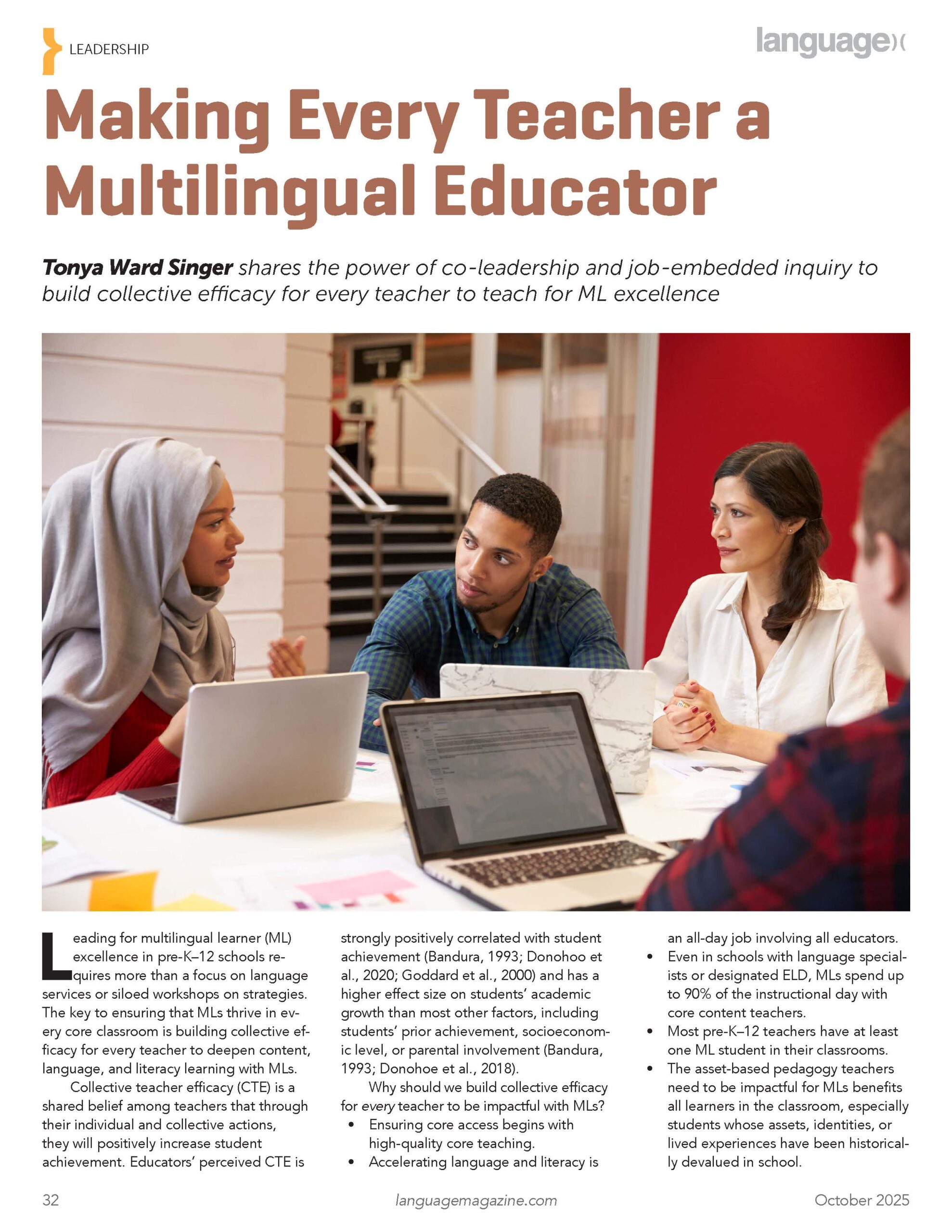

Tonya Ward Singer shares the power of co-leadership and job-embedded inquiry to build collective efficacy for every teacher to teach for ML excellence
Leading for multilingual learner (ML) excellence in pre-K–12 schools requires more than a focus on language services or siloed workshops on strategies. The key to ensuring that MLs thrive in every core classroom is building collective efficacy for every teacher to deepen content, language, and literacy learning with MLs.
Collective teacher efficacy (CTE) is a shared belief among teachers that through their individual and collective actions, they will positively increase student achievement. Educators’ perceived CTE is strongly positively correlated with student achievement (Bandura, 1993; Donohoo et al., 2020; Goddard et al., 2000) and has a higher effect size on students’ academic growth than most other factors, including students’ prior achievement, socioeconomic level, or parental involvement (Bandura, 1993; Donohoe et al., 2018).
Why should we build collective efficacy for every teacher to be impactful with MLs?
- Ensuring core access begins with high-quality core teaching.
- Accelerating language and literacy is an all-day job involving all educators.
- Even in schools with language specialists or designated ELD, MLs spend up to 90% of the instructional day with core content teachers.
- Most pre-K–12 teachers have at least one ML student in their classrooms.
- The asset-based pedagogy teachers need to be impactful for MLs benefits all learners in the classroom, especially students whose assets, identities, or lived experiences have been historically devalued in school.
Making every teacher an ML teacher is a compelling vision shared by many ML advocates, specialists, and leaders. The question, in practical terms, is how.
In answering this question, it is important to understand that building collective efficacy for all educators for culturally and linguistically diverse learners is not a technical problem that can
be solved with a mandate, a checklist, or siloed workshops for language specialists. It is an adaptive challenge that requires shifts in mindsets and ways of working across the entire organization.
Learning from the Research
Research is clear that isolated workshops do not shift instructional practice (Joyce and Showers, 1983). Effective professional learning that results in gains in student learning is content focused, collaborative, ongoing, and connected to teachers’ work in classrooms with students (Darling-Hammond et al., 2017). The experience of collaborating in continuous cycles of data-driven inquiry to reflect and adapt teaching to realize priority goals for student achievement
builds collective efficacy (Donohoo et al., 2020). When core teachers collaborate through asset-based inquiry protocols and a commitment to the achievement of MLs, they realize learning gains for language learners and shifts in their perceptions about their students’ capacities and their efficacy to teach language learners in the core (Singer, 2015, 2025).
Humble Inquiry About Our Impact
Whether we are administrators, coaches, specialists, or core teachers, we are most effective when we engage in continuous inquiry about the impacts of our actions on student learning. Student-centered inquiry is humble work, as it dares us to treat each of our “solutions” (e.g., instructional strategies, adopted curriculum, program design, professional learning initiatives) as theories of action. When we are committed to inquiry about our impact, we don’t teach and lead for compliance with these adopted solutions. We build a culture of adult learning though which we as leaders, teachers, and teams continuously reflect on the impact of our actions on student learning with questions including the following:
- What is the impact of our actions on student learning? How do we know? What is our evidence? Which students are thriving? Which are not thriving?
- When students—or a group of students—are not thriving with our priority goals for all learners, we humbly reflect together, “What will we change in our practices to shift this outcome and ensure they succeed?”
These are courageous questions, as they cause us to seek evidence of what is not working and reflect on what we need to change. Whereas it is common for schools to use data from language learners to design supplemental language services, and for PLCs to use data to sort students for interventions, the work of collaborative inquiry about our impact requires that we also use data to reflect on which of our practices—including the ones we love, including the “solutions” we have led—need to change to ensure all of our students thrive.

Collaborating Through the Six Essentials
The asset-based Six Essentials Framework supports teachers and teams with mindsets, actions, and reflection questions for ongoing inquiry to realize gains in student learning (Singer, 2025). The six essentials include actions (engage, observe, support) and mindsets (value, expect, reflect) that help us collectively deepen our capacity to ensure that culturally and linguistically diverse learners thrive in every classroom, every day.
Through the six essentials, effective teachers and teams:
- Value students’ assets, including languages, cultures, and lived experiences.
- Expect excellence of every learner, with clarity about grade-level expectations and an unwavering belief in the capacity of MLs to realize these goals.
- Engage students actively in every lesson (e.g., via peer conversations, meaning-making, reading, writing, and problem-solving) in support of content and language learning.
- Observe and listen as students engage and analyze student work to gather formative data on assets and learning priorities.
- Support as a process of choosing, losing, adapting instruction to connect students’ assets, and help every learner thrive with the goals.
- Reflect about the impact of our actions on student learning, with agency and efficacy to adapt our next instructional moves to ensure all students thrive.
With these six essential verbs, I encourage instructional leaders to shift the focus from adopting nouns at scale (e.g., a one-size-fits-all list of “ML strategies”) to scaling verbs through the inquiry practices that empower teachers to set grade-aligned goals and collaborate to ensure every student succeeds. Whereas nouns (e.g., strategies, scaffolds, rubrics) are helpful tools, it is through our verbs that we build our efficacy to adapt our teaching in response to student data to continuously improve.
All six essentials matter. Whereas it is common for educators to ask for “more strategies” to support language learners, when you equip teachers with strategies and don’t address expectations, MLs will experience over-scaffolding or watered-down learning. The strategies to strengthen classroom conversations, close reading, and writing (engage) do matter, as do the strategies to scaffold access (support) in every lesson. And the path to building collective
efficacy for teachers to effectively choose, lose, and adapt teaching to ensure their students thrive with ambitious grade-level goals also requires attention to all six essentials.
Reflection Questions for Teachers and Teams
Reflective practice is the process through which educators bring all six essentials into synthesis connected to what we teach and whom we teach every day. The reflection questions help teachers, co-teachers, and teams deepen their job-embedded, data-driven collaboration with a focus on both the actions (engage, observe, support) and the mindsets (value, expect, reflect) that are imperative for ensuring MLs in all of our core classrooms thrive.
To connect these inquiry questions to your local priorities, first identify a high-priority student learning goal to impact through your teaching or leadership. For example, a math team might prioritize strengthening student confidence expressing mathematical thinking in peer conversations. A cross-disciplinary team prioritizes strengthening students’ writing with claims, evidence, and reasoning about content texts and topics. A primary team prioritizes increasing the engagement of all students in peer conversations about texts read aloud. As the focus here is on core access for MLs, think beyond language standards to a rigorous goal that is a priority
in your local context for all students (including, of course MLS).
Asset-Based Inquiry Through the Six Essentials
| Essential | Reflection Questions for Teachers and Teams |
| 1. Value | Does every student feel a sense of belonging and connection in our class(es)? How are we connecting instruction to students’ prior knowledge, cultural and linguistic assets, and lived experiences? |
| 2. Expect | What goal(s) for student learning do we prioritize to impact? What does success look like? What are our success criteria? What aspects of language must students understand and use to excel with these goals? |
| 3. Engage | How will students demonstrate success? What peer conversations and active learning tasks do we structure for this goal? |
| 4. Observe | What do students say and do as they engage? What do students’ words and actions reveal about their assets, understandings, and/or opportunities for learning with this goal? What language choices do students make? What do these reveal about their assets and opportunities to build or scaffold the language essential for success with this task? |
| 5. Support | What instruction and support will we choose, lose, or adapt to help students leverage their assets to thrive with the goal? What linguistic scaffolds or instruction will we provide to support the language needed to thrive with this goal? |
| 6. Reflect | How did our instructional choices impact student learning? How will we adapt our approach to ensure every learner thrives? How did our scaffolding choices impact students’ language use, high-level thinking and risk-taking using a new language? |
(Adapted by author from Singer, T. W., 2025, Asset-Based Lan-guage and Literacy: The Flip-To Guide to Multilingual Learner Excellence in the Core, pgs. 13 and 109. Corwin Press. All rights reserved).
Building Language Connected to Content
There is tremendous power in bringing core teachers together in inquiry about a goal they prioritize to realize with their students, and in this context supporting their attention to language. At each step of inquiry, there is a natural place to reflect on language together with our content goals. For example, a team focused on strengthening academic writing collaborates through the expect questions to clarify their goal. This process includes looking at relevant standards, exemplars of student writing, and writing success criteria—and thinking about the linguistic demands and expectations for success with these tasks.

When we engage students in writing tasks relevant to our goals and analyze their writing, we deepen our insights into both their assets and their learning priorities with the content goals and with language. Getting specific about what we see in the writing is important to go beyond general judgements about students who are given the label EL.
At the stage of co-analyzing student writing, a sixth-grade teacher in a team I was facilitating had an “ah ha” I will always re-member. At first, when he read an essay far below grade level, he said, “You can tell this is English learner.” I asked him to be more specific about what he saw in the writing that needed to improve. “It’s choppy.”
I then asked what he meant by choppy and invited him to compare this essay to one at grade level that was not choppy. Comparing these two writings side by side, he immediately saw the difference—a small difference in language use—a specific skill for cohesion. “Oh! I can teach that!” he exclaimed. “And most of my students need that lesson.”
This student-writing-focused moment in a grade-level PLC helped a core teacher not just deepen insights about language but also make a powerful mindset shift, from “That’s an EL!” to “I understand what I need to teach to help this student strengthen their writing to realize my grade-level expectations.”
Co-leading from Silos to Synergy
Time for professional learning, including workshops, staff meetings, and teacher collaboration, is limited in most districts, and even more so when instructional leaders work in silos. In a large district with many departments (e.g., Curriculum, Literacy, Math, Title I, ML), a siloed approach to professional learning typically results in a scattershot of workshops, teacher overwhelm, and limited theory-to-action, action-to-impact support.
Where silos are the norm, ML leaders and specialists are typically positioned on the sidelines of core instructional initiatives. While there may be systems for teacher inquiry teams or coaching, these are led from another department such as Curriculum, Literacy, or Math. Meanwhile, an ML leader may only have influence over professional learning time with language specialists, or have just enough time with core teachers for the occasional workshop. Language specialists, even when highly trained with impactful pedagogy and co-teaching capacities, rarely have the depth of time (or buy-in) with every teacher to support deep, sustained professional learning.
Co-leadership across roles and departments is foundational to creating the time, focus, and buy-in for the research-based practices that build collective efficacy. In my silos to synergy workshops, I help leadership teams leverage best practices in change leader-ship and instructional leadership to align priorities and initiatives to deepen their impact on students. Consistently, even from the most siloed settings, leaders find opportunities and inspiration for synergy. At the heart of this work is aligning our priorities with a shared vision for student impact, and humility to learn from both student data and the research on impactful professional learning to focus our resources on realizing our student learning goals together.
Celebrating Growth, Shifting Mindsets
It is inspiring to witness the shifts in mindsets that happen naturally as teachers and teams collaborate in inquiry to realize the goals they prioritize for student achievement. When teams collaborate in asset-based inquiry to realize gains for all students including MLs, they both ensure MLs thrive and shift their own mindsets through this experience. Powerful shifts I continue to witness among core teachers who engage in this job-embedded inquiry include:
- From believing grade-level expectations are too high to realizing their students are capable of success with these rigorous goals;
- From asking for more strategies as the solution to using and adapting the many strategies they have with efficacy and agency to teach every student in the room;
- From deferring responsibility for MLs to the language specialist (and students with IEPs to special education) to feeling a shared responsibility for all students.
These shifts are possible when educators collaborate across roles and departments with a shared vision for student success. Different from siloed approaches that put the responsibility for ML achievement on a department or specialist, we together in our co-leadership and our learning communities build collective efficacy—the belief that through our actions we can together ensure all of our students thrive.
References
- Bandura, A. (1993). “Perceived Self-Efficacy in Cognitive Development and Functioning.” Educational Psychologist, 28(2), 117–148. https://doi.org/10.1207/s15326985ep2802_3
- Darling-Hammond, L., Hyler, M. E., and Gardner, M. (2017). Effective Teacher Professional Development. Learning Policy Institute.
- Donohoo, J., Hattie, J., and Eells, R. (2018). “The Power of Collective Efficacy.” Educational Leadership, 75(6), 40–44.
- Donohoo, J., O’Leary, T., and Hattie, J. (2020). “The Design and Validation of the Enabling Conditions for Collective Teacher Efficacy Scale (EC-CTES).” Journal of Professional Capital
and Community, 5(2), 147–166. https://doi.org/10.1108/JPCC-08-2019-0020 - Goddard, R., Hoy, W., and Hoy, A. (2000). “Collective Teacher Efficacy: Its meaning, measure, and impact on student achievement.” American Educational Research Journal, summer (37), 479–507.10.3102/00028312037002479.
- Learning Forward. (2022). Standards for Professional Learning [online]. https://standards.learningforward.org.
- Singer T. W. (2015). Opening Doors to Equity: A Practical Guide to Observation-Based Professional Learning. Corwin/Learning Forward.
- Singer, T. W. (2025). Asset-Based Language and Literacy: The Flip-To Guide to Multilingual Learner Excellence in the Core. Corwin.
Tonya Ward Singer is a biliterate keynote speaker and international consultant specializing in building the collective capacity of every teacher and leader to deepen student achievement in culturally and linguistically rich schools. Her best-selling books include Asset-Based Language and Literacy (2nd ed.), EL Excellence Every Day (1st ed.), and Opening Doors to Equity.