

Youth anxiety, depression, chronic absenteeism, and concerning school behaviors are at an all-time high. At the same time, pandemic disruptions, social media, school shootings, high-stakes testing, and punitive school cultures have made it harder than ever to be a kid—and harder than ever to teach kids, which is driving a mass exodus of educators.
Students with social, emotional, behavioral, developmental, or socio-economic challenges are the most vulnerable to these developments, and the “business as usual” model at many schools just isn’t enough to provide them with the support they need.
Clinical child psychologist, former Harvard Medical School Department of Psychiatry faculty member, and New York Times best-selling author Ross W. Greene has worked with thousands of kids with concerning behaviors. He has overseen the implementation and evaluation of his Collaborative & Proactive Solutions (CPS) framework model in countless schools, families, inpatient psychiatry units, and residential and juvenile detention facilities, with dramatic effect: significant reductions in concerning behavior, recidivism, discipline referrals, detentions, suspensions, and use of restraint and seclusion.
In his forthcoming book, The Kids Who Aren’t Okay: The Urgent Case for Reimagining Support, Belonging, and Hope in Schools, Dr. Greene explains why so many kids are struggling, why traditional discipline makes things worse, and how schools can transform their approach to become proactive, collaborative, and helpful.
Based on decades of research in the neurosciences, Dr. Greene argues that concerning behavior is a child’s frustration or stress response and is not caused by poor motivation. The research tells us these kids are struggling with skills many of us take for granted—flexibility/adaptability, frustration tolerance, and problem-solving. Their frustration responses are set in motion when they’ve having difficulty meeting an expectation.
Punitive, unilateral approaches—detentions, suspensions, expulsions, seclusion, restraint—don’t solve the underlying problems and often exacerbate the child’s frustration, akin to throwing fuel on a fire. Such approaches are late, reactive responses to behaviors instead of early responses to unsolved problems.
Schools struggle to meet these students where they’re at because of obsolete structures that work to the disadvantage of both kids and educators:
- They’re late: a lot of the training educators receive teaches them what to do when students are already escalating.
- They’re punitive: most school discipline programs are still oriented toward disciplinary strategies that focus on compliance and simply do not address what’s really getting in the way for students who are struggling the most.
- They’re unilateral: it turns out that involving students in solving the problems that are causing their concerning behavior is far more effective than adults doing it all on their own.
- They’re time-consuming: unsolved problems take up an enormous amount of time— something that is already in short supply for the majority of teachers.
Dr. Greene has helped schools all over the world be early, proactive, and collaborative, and save time. His CPS framework is a structured, evidence-based way of identifying unsolved problems and fixing them with students, rather than forcing measures on them.
His helpful guide outlines a whole-school transformation that includes:
- Early, proactive identification of student needs;
- Trauma-sensitive environments that replace blame with understanding;
- Prioritization of relationships, co-regulation, and student voice;
- Reallocation of time and resources to upstream work;
- Shifting from compliance to collaboration;
- Reducing reliance on reactive systems (restraint, seclusion, detentions, tiered behavior models) in favor of solving problems collaboratively.
Dr. Greene’s research and experience are living proof that educators can create school ecosystems that meet kids where they’re at and get them on the right track. He urges schools to become safe havens of hope, where adults restore students’ trust and instill them with the skills they need to succeed emotionally, socially, and academically.
See below for an excerpt from Dr. Greene’s new book, The Kids Who Aren’t Okay:
For decades, we’ve been training educators to de-escalate and restrain kids, ostensibly for purposes of “preventing” crises and keeping kids, their classmates, and their caregivers safe. Such training is standard fare in many school systems.
From the outside looking in, these procedures may seem necessary. After all, it is important to keep the “out of control” kids from harming others and detracting from the learning of their classmates. Even on the inside, many educators—and some of their national teacher unions—still believe that de-escalating, restraining, and secluding kids are simply accepted practices for special education classrooms and students.
But others know that there are a ton of problems with this picture. First, there are a lot of schools and treatment facilities serving kids with equally concerning behaviors that don’t use restraint or seclusion. So apparently those practices aren’t necessary and are not the way everyone has always done it. Second, there are no data to suggest that de-escalating, restraining, and secluding kids keeps anyone safer. Third, such procedures are disproportionately applied to students with disabilities and those with black and brown skin, meaning that this is also a social justice issue. Fourth, de-escalation, restraint, and seclusion can hardly be characterized as crisis prevention strategies; they occur very late in a sequence of events that begins with an expectation a student is having difficulty meeting.
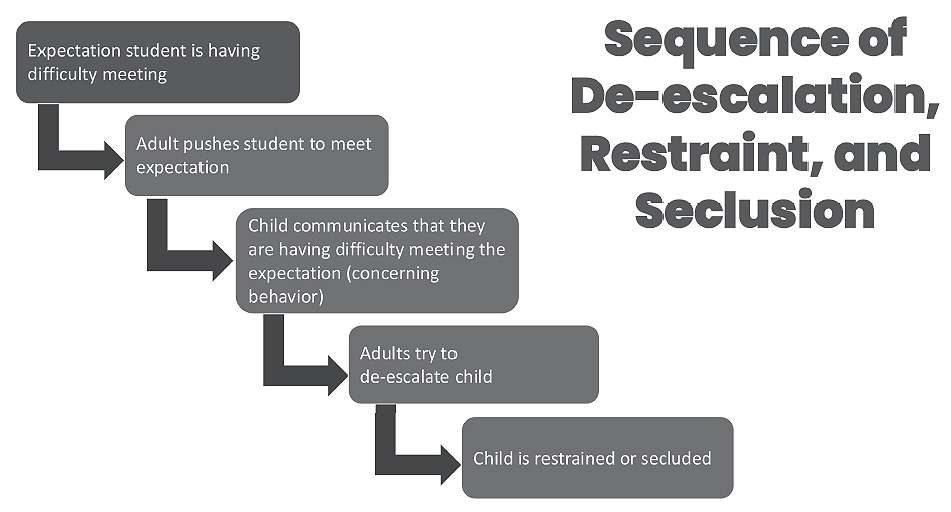
In the first bubble, the student is having difficulty meeting an expectation. That’s seldom surprising, since the expectation has probably gone unmet for a very long time (an unmet expectation is only a surprise the first time; it’s not a surprise after that). Due to a variety of factors—human nature included—adults often respond to such unmet expectations by pushing students harder to meet the expectation they already know the student can’t reliably meet. Pushing kids harder to meet expectations they can’t reliably meet increases the likelihood that a student will exhibit a frustration response (concerning behavior). It’s important to reiterate that the frustration response is late (the student is already having difficulty meeting the expectation, and, again, it’s not the first time). At that point in the sequence caregivers might resort to strategies they learned in the de-escalation training they receive every year. When de-escalating doesn’t accomplish the mission, restraint or seclusion often follows and seems justifiable and necessary. But the fact that de-escalating, restraining, and secluding occur very late in a highly predictable sequence indicates that they aren’t crisis prevention strategies at all; they’re crisis management strategies.
What’s not depicted in the graphic is what comes next, interventions that are later still, including punitive, exclusionary disciplinary practices such as detention, suspension, corporal punishment, and, if the adults have finally had it with the student, expulsion or placement in a special purpose school (where de-escalating, restraining, and secluding kids is often even more likely to occur).
Who’s on the receiving end of these interventions the most? The kids who aren’t doing OK. To save these students from ongoing harm and inexorable decline, and educators from interminable frustration and desperation, we need to stop being late. That means we need to start focusing on the first bubble: the expectations we’re placing on students and what we do if they’re having difficulty meeting them. Those unmet expectations—we’ll be calling them unsolved problems—can be identified proactively (we’ll describe how that’s done in the next chapter) and can therefore be solved proactively or temporarily put on hold (since it won’t be possible to solve all the problems at once). In other words, we’ll be delineating a technology for being early, a much more legitimate definition of crisis prevention.
About the Author
Ross W. Greene, Ph.D. is a clinical psychologist and the originator of the innovative, evidence-based approach Collaborative & Proactive Solutions (CPS), as described in his influential books The Explosive Child, Lost at School, Lost & Found, and Raising Human Beings. He also developed and executive-produced the award-winning documentary film The Kids We Lose. Dr. Greene was on the faculty at Harvard Medical School for over twenty years and is now founding director of the non-profit Lives in the Balance. He is also currently adjunct Professor in the Department of Psychology at Virginia Tech. Dr. Greene lectures throughout the world and lives in Freeport, ME.

TEACH is the largest national education publication in Canada. We support good teachers and teaching and believe in innovation in education.