
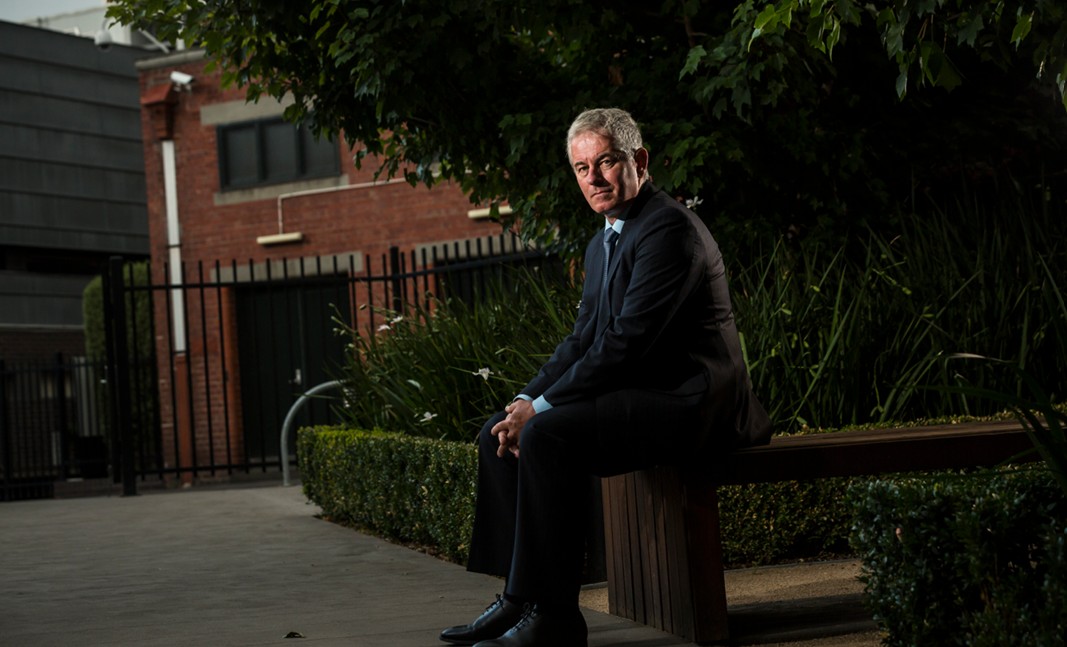
Few have a deeper understanding of principal health and wellbeing than Phil Riley.
As Professor of Education Leadership at Deakin University‘s strategic research centre, Riley studies the overlapping space of psychology, education and leadership. Throughout his illustrious career, he has produced more than 200 publications and peer-reviewed conference presentations.
This tireless, painstaking work has earned Riley multiple national and international awards and – refusing to rest on his laurels – he continues to advise education systems and leadership bodies across Australia and globally.
In 2011, the vast knowledge and experience Riley gained over his years of working with schools, system leaders, and governments, culminated in the Australian Principal Occupational Health, Safety and Wellbeing Survey, which he compiled together with the Australian Catholic University’s Institute for Positive Psychology and Education (IPPE).
‘Principals are the canary in the coalmine’
The Survey, now in its 15th year, shines a light on the diverse challenges faced by school leaders in Australia and New Zealand, offering an at times alarming glimpse into the sheer complexity of Principalship, and the impact it has on their professional, and personal, lives.
“I began this study 15 years ago with a focus on Principals rather than teachers not because they are more important than teachers or students but because the impacts of the system are seen more clearly by focussing on this group of educators,” Riley told The Educator. “They are the canary in the coal mine.”
Riley said most Principals and teachers care passionately about working with young people to help them become the best they can be, so they find it distressing to implement policies that do not help that cause.
“This is called moral stress in the academic literature.”
If the latest data from the IPPE is any indication, that moral stress is no longer simmering beneath the surface – it’s pushing many Principals to the brink.
Principal health and wellbeing in ‘dramatic decline’
According to the survey conducted between 2024-2025, there has been a “dramatic decline” in Principal health and wellbeing, with exposure to violence, stress and workload notably worse than when the landmark study began in 2011.
The researchers describe stress, burnout and workload pressures as reaching “critical levels”.
One of the most disturbing findings from the report was that nearly half (47.8%) of Principals reported experiencing physical violence and more than half (53.7%) faced threats of violence in 2025.
Anxiety and depression rates among school leaders are high, with 10.3% of Principals recording severe anxiety scores, and levels trending upward since 2023. On average, they’re working almost 54 hours a week.
The report’s findings also have worrying implications for Australia’s leadership, with more than half (54.4%) of school leaders seriously considering leaving their current job. The survey’s authors noted that this has been “a consistently high figure” since this was first assessed in 2023 and has not become a downward trend, rising from 53.2% in 2024.
‘Educators are not trusted by politicians or bureaucrats’
“The most disappointing aspect of the survey results after 15 years is that so little has been done to reduce the administrative workload of both Principals and teachers,” Riley told The Educator.
“Both groups must spend an inordinate amount of time on very low-level administrative work justifying their existence.”
Every year since the ACU’s report into Principal health and wellbeing was first released, the two highest stressors for Principals every year have been the “sheer amount of work” and the “lack of time to focus on teaching and learning”.
Riley said he’s convinced that “exactly the same results would be reported by teachers.”
“Yet the administrative burden increases rather than decreases every year as bureaucrats demand more reporting and deeper levels of detail about the work that teachers do,” he said.
“This takes up a huge amount of their time and prevents them from actually doing the work of teaching and encouraging learning.”
Worse still, said Riley, it sends a “subliminal message” that they are not trusted by their own Departments of Education.
“I think the body of evidence that this survey presents makes it pretty clear that educators are not trusted by either politicians or bureaucrats.”
A problem of ‘gatekeeping’ and ‘functional stupidity’
A root cause of the Principal health and wellbeing crisis, says Riley, is a deeply embedded culture of ‘gatekeeping’ within the education bureaucracy.
From his experience briefing bureaucrats in Departments of Education here in Australia and in other parts of the world for more than a decade, he has come to see a consistent pattern in how decision making and priorities play out behind the scenes.
“I have come to the conclusion that the main bureaucratic currency, is information/knowledge and the main task of each individual is to cover their own arse first and foremost,” Riley told The Educator.
“This may be more prevalent in lower rather than senior levels of the departmental hierarchy. Information/knowledge gained by one section of the department would be shared widely, and indeed across other departments in a fully functioning service organisation like the public service.”
However, Riley said the reverse seems to be the norm.
“Important and unimportant information/knowledge is withheld from others in the department who would benefit from seeing it, so it can be used strategically for individual bureaucrat’s benefit or simply as protection,” he said.
“For example, Principals are often asked by different sections in the same department of education for identical information multiple times because each subsection of the department is holding the information they receive close to their chest rather than sharing with their colleagues down the hall.”
Riley said this means Principals must waste time supplying the same information repeatedly to the departmental superiors, which they found “very frustrating”.
“There have been some attempts by some departments to deal with this over the years, however, the culture seems too strong to break down in any meaningful way.”
Policy detached from reality
A related issue that also deserves greater attention, said Riley, is the “increasing timidity” within education departments.
“No one wants to be attacked for a decision they have made so the default position seems to be either avoid making decisions in the first place; and/or devolve the responsibility for any decisions to others,” he said.
“For example, I was told of an email from a DoE that went out to schools the day before the first day of Term 1 [year not specified] that had 35 attached documents each with separate a list of significant tasks for the Principal to complete before school opened the next day.”
Riley said this included cleaning the gutters of every building as a bushfire prevention strategy.
“Needless to say, older wiser Principals who had been around the system long enough rolled their eyes, did what they could and wondered about the real-world disconnection of their departmental masters,” he said.
“But imagine the newly appointed Principals for that year reaction to that email… very high levels of stress and a complete distraction from their main task the next day, to welcome students back for the new school year and set the emotional tone for the school community.”
And there is even a whole theory about this, Riley pointed out.
“It’s known as ‘Functional Stupidity’, and was developed by Alvesson and Spicer,” he said. “One of the elements is how work settings and organisational culture turn smart, competent people into workers who become unable or unwilling to use their intelligence for the good of the organisation.”
Instead, said Riley, these people instead see their role in very narrow terms which can often lead to poor decision-making.
“I think we are there in education right now.”
‘The lack of trust will break the system completely’
Riley said that when talking about solutions to the Principal occupational health, safety and wellbeing crisis it’s important to keep in mind that it is not separate from the health and wellbeing of the school system as a whole.
“The divide between rich and poor is the greatest single threat to our school system as a whole and it is continually widening,” he said. “This goes to taxation, health and welfare policy as much as education policy.”
As for NAPLAN scores, Riley said these are far more a reflection of socioeconomic status than teacher quality and educators of all types “feel insulted when this is not pointed out by those who should know better.”
“You cannot just fix the education system in isolation. And the politicians don’t really help,” he said, adding that education policy gets reduced to short-term ‘announcables’.
“Announcables, as bureaucrats call them, are designed primarily to fit a 15 second media grab – not incrementally improve education,” Riley said.
“If we continue down this path, doing the same and expecting different outcomes – which is Einstein’s definition of insanity – the education system will lose their best and brightest in all sorts of ways that have already begun and have been worsening over the life of the survey.”
Riley said this will lead to smart people being turned off becoming teachers and principals.
“This too is already happening. Governments wanting to save money will behave like the current Victorian government and continuously cut spending on education,” he said. “The more state schools are marginalized the more social dislocation we will see.”
Riley said the most harmonious societies are the most equal.
“If the profession is not fully supported by the governments that oversee them, the lack of trust in educators will eventually break the system completely,” he said.
“Fifteen years of solid evidence should be enough for us to say ‘time for a change’”.
Finland’s model offers a way forward
Riley said the transformation of Finland’s education system offers a powerful lesson in what’s possible when policy is guided by long-term vision rather than short-term politics.
“When Finland, in the 1950s, was in a pretty similar position to that we see in Australia now, with many children attending private schools and the state system in danger of becoming the poor cousin, they decided that the best resource their country had was its people so they needed to provide the best education system to extract maximum value,” Riley said.
“It was a long and difficult transition, but they depoliticised education and left the running of the system to the experts.”
Riley said that while the process took decades and dedication, Finland’s education system became the envy of the world.
“Schools are part of society, not separate from it. Short term quick fixes simply do not work in something as critical and complex as the education of a nation,” he said. “We need to be courageous and do our version of fixing the system from the ground up.”
However, Riley said this must start with the “depoliticization” of education as the Fins did.
“We must not look to blame any individuals or groups: it is our shared experience, and it is our collective responsibility to fix it,” he said. “Our aim should be to have every child attend their local school because they get an equally good education wherever they go.”
Riley said that when the education of children is taken as seriously as that, everybody’s health and wellbeing will improve – irrespective of what industry they work in.
“But it will take time and courage,” he said. “I wonder if we can find the courage to begin.”