

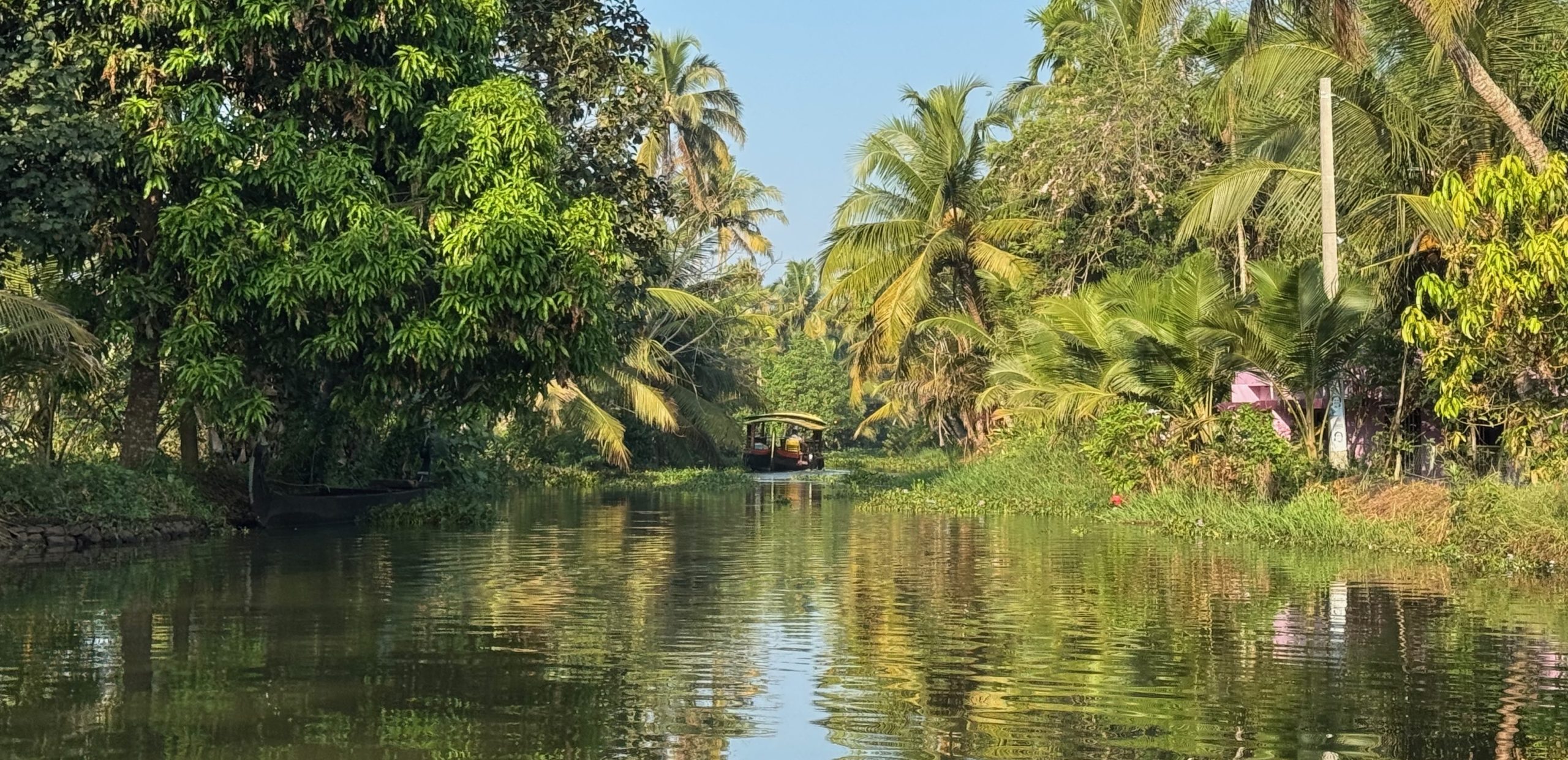
And all we could see – between river and sky – was flora and fauna, and all we could hear was the bubbling of the water through which we wended, the call of myriad birds, and the occasional shout or laughter from families living at the water’s edge.
We saw Kingfishers (White-breasted, Small Blue, and Pied) and Herons (Pond, Grey and Purple), Teals, Terns, Cormorants and Egrets, Black Bitterns and Brahminy Kites, and the ubiquitous Indian Darter (or snakebird). And we heard much more besides – such as the oop-oop-oop of the Greater Coucal.
Backwater thinking in schools
The contrast between ‘we saw nothing’ and ‘the water is alive’ has stayed with me – because I recognise it. So, too, in schools, the micro-lens of quiet and slow, attuned and intentional observation renders visible what the noisy, polluting paradigm of traditional assessment will never let us see.
If we rush and rumble relentlessly along the school highway, so much of what we want and need to see and know in our students will vanish, disturbed beyond sight by the wake we leave behind. If we want to tune into these critical frequencies, we need something simultaneously more and less than data; and, at once, bigger and smaller too: what I call Antidata.
Scientists estimate that only 5% of the universe is visible matter, with the other 95% either dark matter or dark energy. This is a sobering statistic, but what if the things we have always measured, and are still measuring today – the orthodoxy of assessment in schools – also captures only a small proportion of what is happening?
What of the student who is learning lots, but simply struggles to answer the questions on a test? What of the child who feels the cold lack of any sense of belonging, but responds to a survey with the answers they know their teacher would like to see? What of the teenager who is wrestling with trauma, or trying to withstand the microaggressions of identity-based harm, but we see only what we enter on the system as behaviour incidents?
Interspecies and indigenous epistemologies reject the hegemony of rational, empirical knowledge, and embrace, instead, a plurality of knowing. However, in schools, have we learned to ignore our gut, our senses, our intuit, in favour of what can be captured in a neat, quantifiable rubric?