

From launching New York State’s first online school program to designing future-ready libraries and libraries and developing groundbreaking apps like the tether interactive whiteboard, Andrew Taylor has repeatedly set new standards for integrating technology into education.
“I’m privileged to be in a very progressive and innovative district that has some amazing programs,” says Taylor, Director of Technology & Innovation and Chief Information Officer for Chappaqua Central School District 66. “We’ve got a great STEM program that works with K-12 not only in coding and robotics, but also hydroponics with a greenhouse in our high school and an EV program where we’re teaching about electric vehicles. They are creating two-wheelers and three-wheelers in the middle schools and they are creating an entire EV car in the high school. They’re doing some amazing things.”
Taylor was recently recognized with an Innovative Leader Award during a recent Tech & Learning Regional Leadership Summit. He shares his independent work with a team of educators leading the development of EDmotionsAI, the world’s first Emotional Management System (EMS) for schools.
Inspiration Meets Need

Taylor credits being based in such an inspiring district for the motivation to really think outside the box and find new solutions in the education world. One of the most pressing needs led to the development of EDmotionsAI with a team of independent educators passionate about student wellbeing.
“I’m often surrounded by educators in both social and professional settings. The conversation often goes to the fact that we have a student mental health crisis,” he says. “I started talking to SEL experts about what we could do with technology to offer support, which is how EDmotions was born.”
Schools have a broad variety of data-driven ways to assess students academically. When considering social-emotional strengths, the bulk of data to draw on is merely behavioral.
“That’s not really great data,” Taylor says. “It’s not telling you whether students are struggling, it’s just telling you that they’re acting out. We dug into it and created this platform that is pretty unique and gaining a lot of attention right now.”
Taylor feels a data-driven EMS is a natural addition for schools.
“We have nothing that helps us manage or regulate or track these social emotional skills,” he says. “We believe that emotional regulation, resilience, and interpersonal effectiveness aren’t optional skills; they are essential for student success and lifelong well-being.”
It might seem counterintuitive to lean on AI as a human emotion and social skill helper, but Taylor disagrees.
“A study revealed that 5.4 million kids a week go to generative AI chat to get mental health support,” says Taylor. “Those systems aren’t built to do that. We wanted to know, could we build a system that does that kind of support well? We’re not a therapist, that’s not what we’re trying to do. We’re trying to train kids on how to recognize their emotions and then find strategies to manage them.”
How The AI-Powered SEL Platform Works
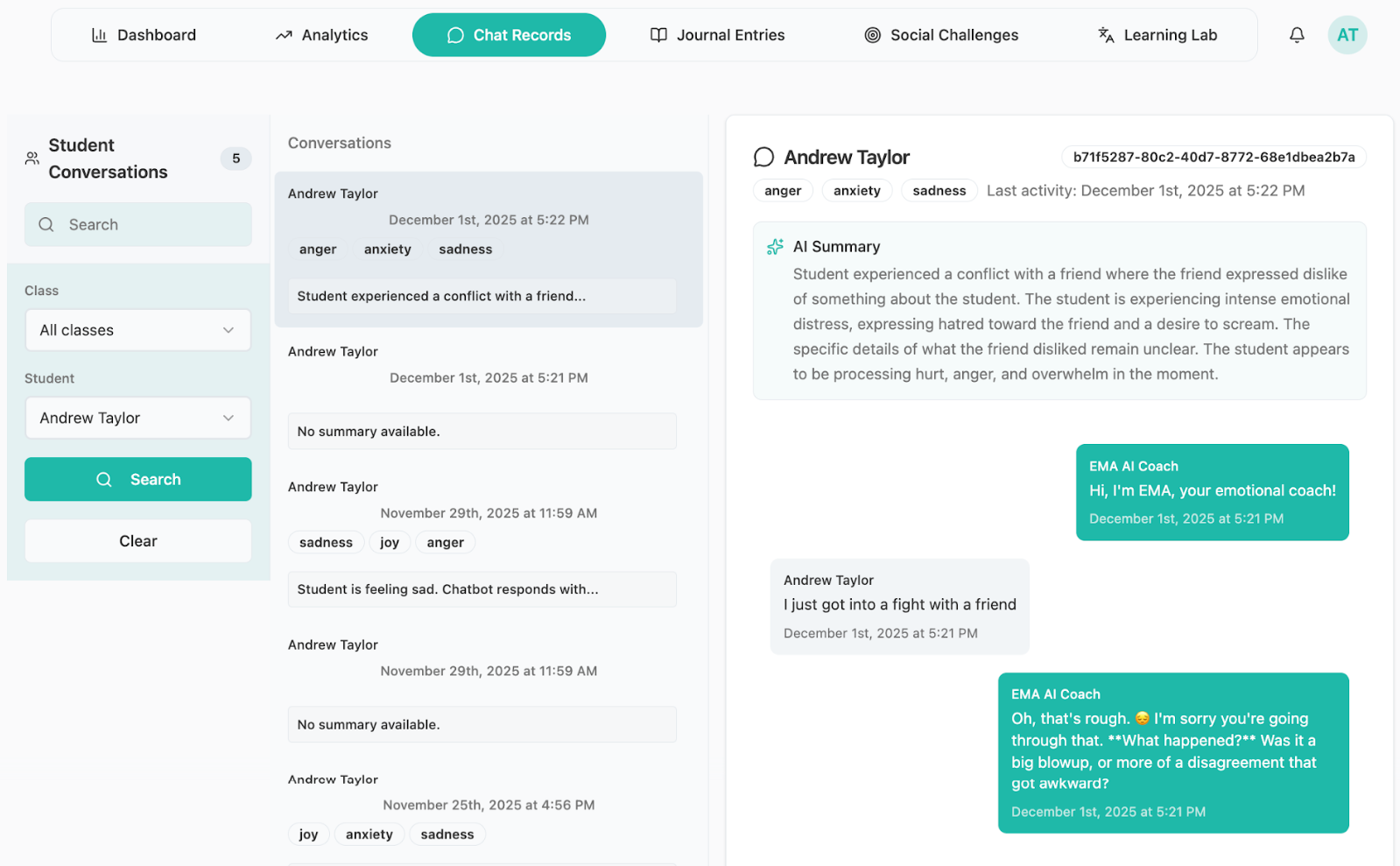
The EDmotionsAI platform is unique in that it tracks 10 emotions, both positive and negative, in varying degrees. A student can feel a certain degree of an emotion, as well as multiple emotions at a time, for a more authentic expression of how they are feeling.
“We wanted to teach kids that you can have diametrically opposing feelings, you can be both happy and sad at the same time,” Taylor says. “It’s the “name it to tame it” strategy. You name your emotions and then tame your emotions.”
Taylor’s team partnered with Dialectical Behavior Therapy (DBT) experts Drs. Elizabeth Dexter-Mazza and James Mazza, among others, to ensure EDmotionsAI has conversations with students in a way that is helping them identify, recognize, and give strategies to deal with emotions.
The program offers a multi-prong response system, including concrete prompts for positive social interactions and a journaling component.
“It also offers a social component that gets kids off the computer, encouraging them to do acts of kindness — go open the door for five people today, invite a new person to your table for lunch, give someone a compliment,” says Taylor. “These are skills that younger kids sometimes feel uncomfortable doing, but when you do things for others, you’re really doing something for yourself. You are building your own self-esteem, building your own internal compass.”

Taylor hopes using AI in strategic ways can help create a culture of belonging inside the school.
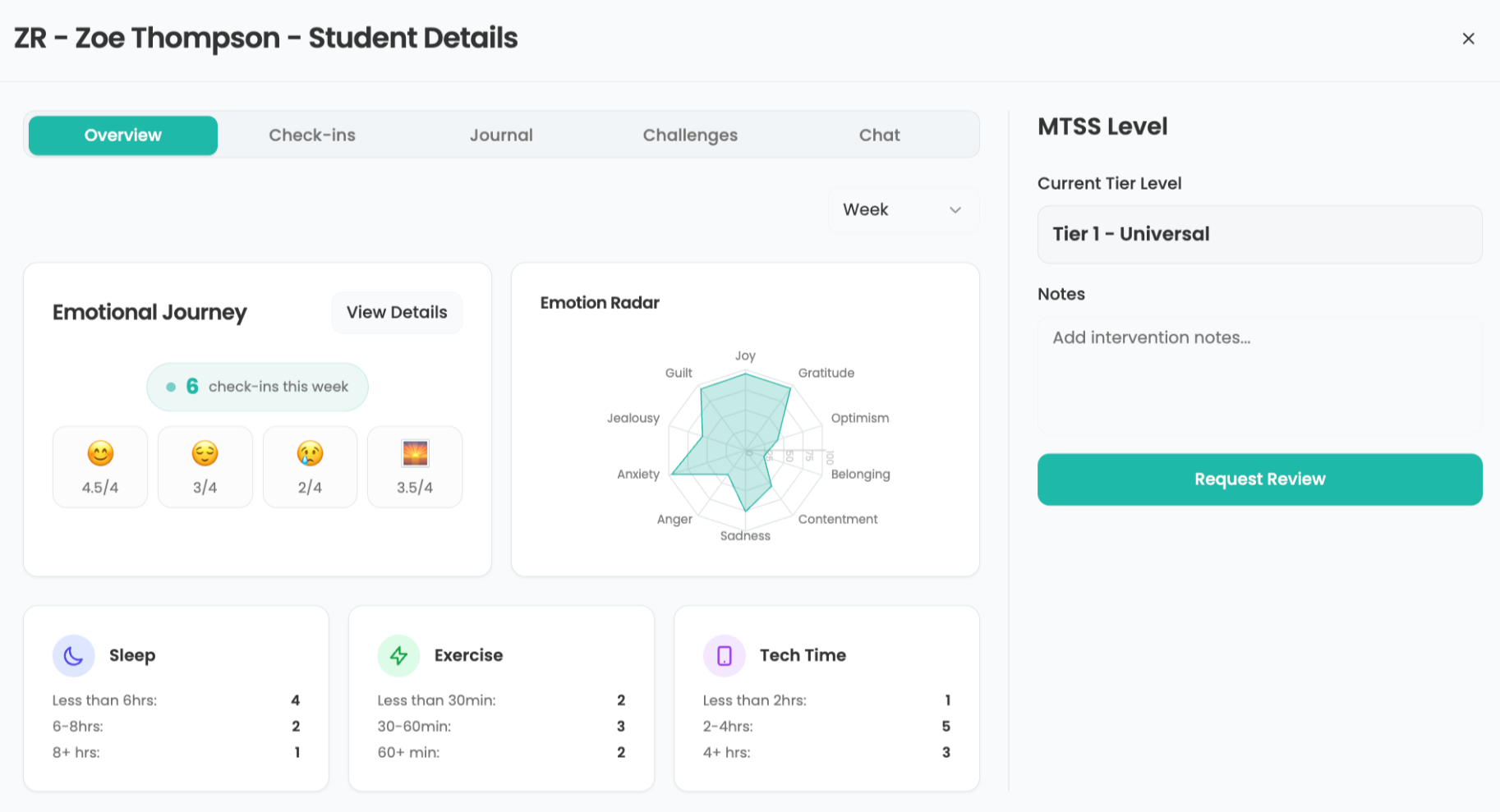
“If you are a teacher sitting in front of a class of 28 kids, who are the three kids you need to talk to today?” he says. “You might notice the student who is acting out, but you might not know another kid is sitting there silently struggling. Our system helps teachers by saying, ‘Here’s three kids you might want to connect with today because something’s happening in their life they might need some support with.’”
While Taylor called on his experience as a data privacy officer to meet or exceed every standard of data protection from outside entities, the platform is made to be an informational tool within the district with students being clearly informed their chats could be viewed.
“When we were testing, we wondered if that aspect would inhibit kids from using the system,” he says. “What we realized is, no, these kids want to be heard. They just don’t know how to talk to you or start that conversation. No one in the school knew these things were happening to the students until they were given an opportunity to talk to this inanimate object. This chatbot revealed what was going on so that they could get support and the resources they needed.”
This insight can be lifesaving.
“Our system is built to monitor for triggers with a background algorithm that weighs the different emotions and alerts the school for support,” Taylor says. “One student seemed to just be a quiet kid. He was getting okay grades, he really wasn’t acting out in any way or a problem on anybody’s radar. But after doing some work with the program, he discovered that he really suffers from severe depression and actually had self-harm thoughts he was expressing in his writing.”
Once aware, educators were able to get the student proper support.
“Through simply chatting with a bot, he was able to say things he was never able to say to the people in his life,” Taylor says.
4 Benefits to An AI-Powered SEL Monitoring Program
- Time-intensive SEL programs are hard to implement with fidelity. The best way to teach SEL is on demand when kids need it. Use microlearning opportunities — inject 10 minutes, three different times per day, instead of one whole period. This nets improved data and helps students better regulate their emotions throughout the day.
- Academic performance is going to increase when kids feel better. SEL provides stability to help kids focus on learning. “If I’m not socially and emotionally ready to be in the classroom, I’m not going to be ready to learn or take in content,” says Taylor.
- Improve school culture. When students feel a sense of belonging, autonomy, and that they are important and heard, their attendance is going to improve, which will improve performance.
- Improve the teacher burnout rate in education. Teachers are leaving the profession early. During exit interviews with teachers, many say it’s because the profession has changed. “They say, ‘It’s not what I thought it was anymore. More of my time is spent managing emotional issues of the students in my classroom,’” Taylor says.
Creating An AI-Powered SEL Platform For Educators, By Educators
Educators felt so strongly about the need for a tool to help, they put their money where their mouths were.
”Our initial round of investment for the program raised around $600,000, and almost 90% of that was actually educators putting in money,” says Taylor. “The people in the field who felt this was a really needed product were putting in their savings, anywhere from $10,000 to $20,000. So I’m pretty proud of that. This is not just something that was created for education, it was created by educators.”
It was also not created by one bright mind. The project grew from kitchen table talks with his social-worker-turned educator wife and more than 40 educators to brainstorming with a bigger educator community on how to build something that could help students and educators at the same time. It also featured targeted use of budget funds with concrete backup for school board or community stakeholders. The full platform with all of the data components includes a data-rich backend that can help efficiently allocate resources.
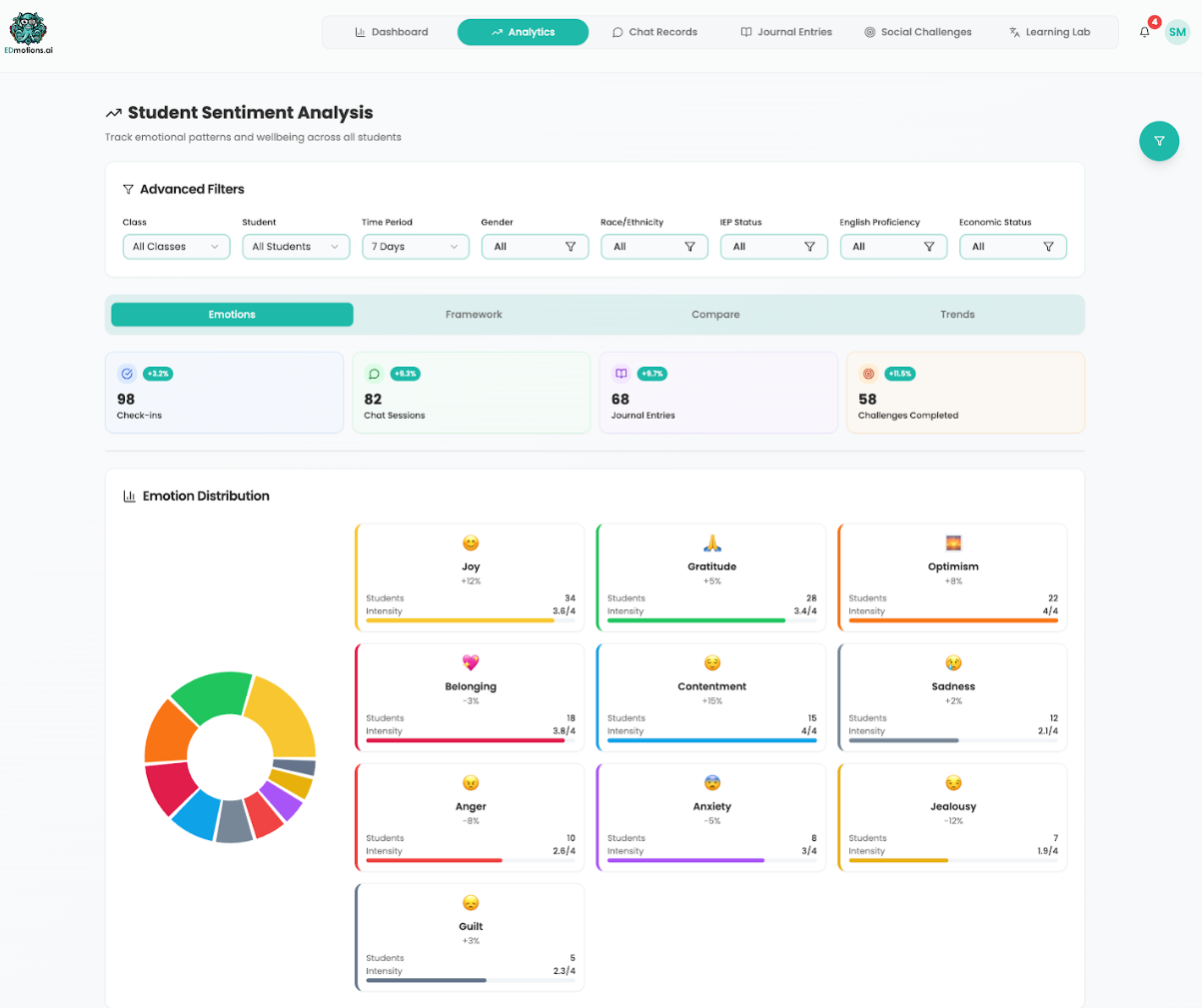
“It allows you to look at how your school is comparing against different frameworks like CASEL or DBT,” Taylor says. “You can look at subgroup populations, so you can see different groups of students who might need more attention. Do the males need a specific program that is maybe different than the females in our school? Should I focus on our IEP students?”
Taylor is excited for the future of the platform, including the potential to add an audio or video component with additional social cues to the existing text-to-speech/speech-to-text accessibility feature.
“The next stage is culture and climate,” he says. “The data we have is ripe to be able to give you a picture of what the culture of your building is and how that culture changes over time. What does student to student interaction look like? What does teacher to student interaction look like through the eyes of the students and the union of the system?”
While the myriad of AI uses is hotly contested in education circles, offering creative solutions to meet SEL needs is always welcome.
“By embedding real-time emotional coaching, mindfulness prompts, and social-emotional learning into students’ daily experience, EDmotionsAI helps turn emotional growth from a ‘nice-to-have’ into a routine part of schooling,” Taylor says.
Taylor discusses the tools he and his colleagues use to support EDmotionsAI:
- Classlink — “Our technology partner that helps streamline access and integration across educational tools, making sure EDmotionsAI works seamlessly within existing school systems.”
- DBT in Schools — “The global leader adapting Dialectical Behavior Therapy (DBT) for K–12 education; together we embed evidence-based emotional regulation, mindfulness, and interpersonal skills into the school day.
- Break the Hold — “A partner dedicated to helping break cycles of emotional distress, and supporting youth empowerment and mental-health awareness.”
- Prompt Inversion — “Working with us to refine and tailor the prompts and AI-driven interactions so that each student’s experience feels personal, supportive, and growth-oriented.”
- Lighthouse DIG — “Collaborating on social-emotional learning, data insights, and community outreach, helping us link emotional wellness with measurable student outcomes and school culture.”