

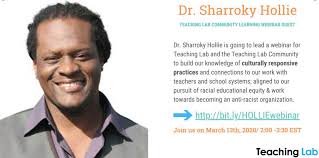
Sharroky Hollie seeks validation and affirmation of the nonverbal language practices our students bring with them
During my early academic studies in linguistics, I was introduced to the six dimensions of language, a framework that has shaped every layer of linguistic understanding I have gained since. Their usefulness has truly stood the test of time. Even now, I can recite and explain them without hesitation: phonology (sounds), morphology (morphemes), syntax (grammar), semantics (meaning), pragmatics (nonverbal and contextual use), and discourse (discussion style and extended communication). Coupled with more than 20 years of experience working with thousands of educators across the US and Canada, I have learned that of all six dimensions, the pragmatic dimension is the most misunderstood and the most underestimated.
Pragmatics addresses how language is used in social contexts, with attention to situational norms, expectations, and relationships. We communicate far more through facial expressions, gestures, posture, eye contact, and tone than we do through actual words. These nonverbal linguistic cues are legitimate cultural expressions that vary significantly across communities around the world. Yet a persistent lack of understanding about pragmatic language use remains among many educators, despite decades of linguistic research demonstrating that a substantial proportion of human communication is nonverbal.
Anthropologist Edward T. Hall, in The Silent Language, famously described pragmatics as exactly that—the unspoken, yet deeply meaningful, dimension of communication. He writes, “It isn’t just that people ‘talk’ to each other without the use of words, but that there is an entire universe of behavior that is unexplored, unexamined, and very much taken for granted.”
This lack of awareness often leads to hidden biases. Over the years, I have accumulated dozens of testimonies—confessions, really—in which educators acknowledge their misinterpretations of students’ attitudes or behaviors based solely on nonverbal cues. One of the most common examples is eye contact. Even in the 21st century, students who do not maintain eye contact are frequently perceived as disrespectful or inattentive. Classroom management systems often reinforce this bias through rules such as “eyes on me,” under the assumption that attention and respect are universally demonstrated in the same way. Yet we know this is untrue. In many cultures, maintaining eye contact signals respect, attentiveness, or engagement—while in others, averting eye contact communicates the exact same thing. The meaning is wholly dependent on cultural norms and context.
Another example of linguistic misunderstanding occurred in France several years ago but remains instructive today. In the mid-2010s, some public schools banned students from sucking their teeth—a gesture known as le tchip—because teachers perceived it as rude or vulgar. For many students of African or Afro-Caribbean descent, however, le tchip is a meaningful cultural expression within a broader system of pragmatic communication. The failure to recognize its cultural legitimacy led to punitive practices that disproportionately targeted these students.
As we move into 2026, my hope is that we bring heightened attention to pragmatic language use as a central component of communication and as a deeply cultural practice. In culturally and linguistically responsive (CLR) terms, we must seek to validate and affirm the nonverbal language practices our students bring with them (Hollie, 2018). Validation and affirmation require us to uncover our blind spots, acknowledge our biases, and resist jumping to conclusions. When confronted with behavior that we might initially judge—an eye roll, a particular tone, an akimbo stance, exaggerated hand gestures—we must pause and ask: is this behavior cultural or linguistic?
Only by asking that question consistently can we build classrooms that honor the full humanity and linguistic richness of our students.
References
Hall, E. T. (1973). The Silent Language. Anchor Books
Hollie, S. (2018). Culturally and Linguistically Responsive Teaching and Learning: Strategies for All Students (2nd ed.) Shell Education.
Sharroky Hollie is a national educator who provides professional development to thousands of educators in the area of cultural responsiveness. www.culturallyresponsive.org