

In 2024, Balmoral State High School embarked on a three-year whole-school journey of exploration and learning to build a school community with student engagement at its core. The aim is to stem the epidemic of disengagement characterised across recent educational research and data.
“Our aspiration is to replace this systemic malaise with a culture founded on student agency – inspiring all students to pursue personal excellence in learning,” explains principal Timothy Barraud. “As a school, we are dedicated to transforming classroom engagement from mere participation to meaningful investment, driving impactful, sustained academic growth and adaptability.”
The Term 3 2025 Attendance and Belonging Survey revealed:
-
75% of students view their classroom as a welcoming space where teachers help them connect with learning and peers, while the same proportion feel encouraged to reflect on their learning
-
70% reported being challenged to think more deeply
-
67% felt noticed when doing their best
-
63% agreed teachers had a precise commitment to knowing them as individuals
Boeing Excellence Program: Maintained a 20-year partnership with Boeing, providing students with real-world aerospace challenges. Through programs like the Boeing Academy and Enterprise Team, students design projects – such as planning a facility for Australia’s MQ-28 Ghost Bat aircraft – and receive professional industry feedback.
Aerospace Gateway School: Collaborating with Aviation Australia and partners like UQ and Griffith University, giving students unique pathways into aerospace and engineering fields.
Horizons Academy (Year 7 Selective Excellence Program): Flagship program cultivating high-achieving students through advanced learning experiences in critical and divergent thinking, collaboration, innovation and communication.
State-of-the-art facilities and flexible learning environments:
-
iNNOVATiON Space / Innovation Block: Modern learning facility features flexible classroom designs developed in partnership with Queensland University of Technology researchers, designed to enhance student agency, inclusive practices and adaptable teaching methods
-
Advanced Science Labs: Equipped with modern, air-conditioned science labs, the school supports hands-on, research-based learning
-
Industry-standard laser cutters to expand STEM, prototyping and design capabilities
-
Refurbished flight simulators secured through industry partnerships, enabling immersive learning experiences for aviation students
-
RASCube Educational Satellite Kit purchased in partnership with Robinson Aerospace – allowing students to design, program and engineer solutions using a custom satellite system
-
Development of a bespoke aerospace curriculum shared with Queensland schools and embedded into Years 9–10 Aviation and Technologies
Barraud adds, “Over the past 18 months, Balmoral State High School has demonstrated a laser-like focus on building a culture that celebrates students as active participants in their learning. Recognising the inherent complexity of school environments – where competing priorities, both internal and external, can dilute clarity of purpose – we determined that engagement and agency must sit at the centre of all that we do.”
Kenthurst, NSW

Hills Grammar formed a FutureNow Taskforce consisting of over 90 executive members, years 5-12 students, teachers, parents, school council members and university critical friends who meet fortnightly. The initiative was launched with a provocative presentation by Professor Yong Zhou and Professor John Fischetti, who challenged the team to question the current model of schooling.
The team then developed Hills Archetypes for the Future:
-
Nurturing identity: Cultivating social and cultural identity and a sense of belonging, value and purpose to enable students to thrive
-
Deepening learning: Focusing on mastery of skills and knowledge, inspiring curiosity and providing transformative learning in and beyond the curriculum to develop deep understanding and an ability to apply the learning and work collaboratively to identify and solve complex problems
-
Fostering ethical leadership: Inspiring students and staff to lead with integrity, compassion and courage
-
Growing entrepreneurs and agentic universal citizens: Fostering adaptive enterprise skills, student voice and agency and service informed by compassion, openness and tolerance to a wider community and beyond
-
Embracing technological innovation: Liberating and enriching learning and harnessing technology for personalisation, creativity and collaboration
-
Promoting environmental thriving: Empowering staff and students to make informed decisions and take actions that contribute to sustainable futures
-
Enabling agility in career navigation: Ensuring students are adaptive, resilient and confident so they are future fit for the world beyond school and the workplace
Principal Karen Yager says, “Our FutureNow collaborative approach is about embracing innovation and finding blue-sky solutions to ensure that education continues to be inspiring and engaging, so that young people face the world with agency and optimism.”
The first metric used to judge the success of FutureNow was the number of executive members who remain in the team and attend the regular meetings, which stands at 85%. In the last 12 months, the numbers have grown rather than dwindled once the level of commitment required was evident. A further nine students, five parents and seven parents joined the team.
The second metric was the number of initial key “blue sky” ideas developed by the small groups that were shared with the whole team. The seven groups developed, on average, six innovative and challenging ideas that were research-informed and provoked the Task Force team to think outside the box. Some of the examples included:
-
Using NotebookLM as a student Independent Learning tool for students to set learning goals, identify areas that need improvement and identify an area of passion that they would like to learn more about. This would be piloted with Year 8 students in 2026.
-
Entrepreneurship + incubation and start-up hub with local community, business mentors and start-up leaders. The Hub will encourage entrepreneurial thinking and innovation among students through real-world business challenges, mentorship, and community collaboration.
-
Developing Generative Artificial Intelligence (GAI) Bots to be used as ‘tutors in the pocket’ by Year 5–12 students.
Primary teachers and 7–10 geography teachers enable their students to use microbit sensors. Year 6 students use the sensors for their sustainable agriculture inquiry learning projects.
Year 10 geography students measure the CO2 emissions using the sensors and investigate how trees and plants reduce the emission levels. The Year 9 students developed Vex robots for their interdisciplinary project that focused on all students developing rudimentary to advanced coding skills, depending on the students’ coding skills. While a Hills Grammar team competed successfully in a national VEX robot competition.
Three-dimensional printing has become an integral feature of many subjects and co-curricular programs:
-
The Project Change team created Australian animals and birds found on our school campus and sold them to our students to raise money for the Save the Platypus cause.
-
Year 12 Design and Technology and Visual Arts students incorporated 3D developed objects into their major works.
-
Year 7 students used 3D printing for their rollercoaster projects for a STEM interdisciplinary project.
“We are an innovative school, as we are future-focused. In the past 12 months, Hills has continued to extend microcredentialing that acknowledges students’ achievements and skills beyond the classroom,” adds Yager. “We have implemented sustainability initiatives, partnered with international schools to deepen intercultural understanding, and supported students to compete in the Model United Nations in New York, representing Australia.”
Warwick, Qld
SCOTS PGC College’s SCOTS MyWay program has shifted the traditional model from “one size fits all” to a personalised, future-focused framework where every student leaves school with meaningful qualifications, industry experience and a clear sense of purpose.
At the core are two distinct but interconnected pathways:
And they are supported by a pair of pioneering programs in Years 10 and 11:
-
StudyPrep equips students with the academic discipline and tertiary-ready skills to thrive in university settings.
-
WorkPrep builds employability skills, vocational competencies and crucial real-world understanding through structured internships with local businesses and a focus on regional enterprise.
“The success of SCOTS MyWay stems from an interconnected ecosystem of innovations, each reflecting our belief that learning must be authentic, rigorous and connected to the world beyond the classroom,” says Amy Woodgate, acting principal (Strategy) and director of girls’ boarding.
UniPrep academic performance: 100% of participating students completed AEP1111: Transitioning to University in Semester 1 2025. Of these, 17 achieved a High Distinction, 20 achieved a Distinction, 16 earned a Credit and three earned a Pass – results that demonstrate readiness for university-level expectations.
Internship engagement: Every Year 10 WorkPrep student has completed three industry placements, gaining experience in multiple sectors to broaden their career perspectives. Qualitative feedback from industry partners is analysed to better understand the strengths and challenges of students to inform teaching.
Student and parent feedback: Surveys consistently highlight the value of authentic learning experiences, with parents reporting increased confidence in their child’s post-school direction. The modified Year 10 WorkWay curriculum has also resulted in higher engagement and improved GPAs.
Industry partner endorsements: Businesses have praised student engagement, adaptability and workplace conduct, with several offering follow-up work opportunities or school-based apprenticeships in Year 11.
Year 9-10 semesterised electives: Encouraging curiosity and reducing disengagement by allowing students to explore multiple disciplines, helping them make informed pathway decisions. The semesterised approach enhances student agency and choice, enabling them to either pursue a broad range of subjects or specialise in a particular discipline. As a small regional school, this approach has allowed them to offer a broader range of electives than would be possible if restricted to single-year offerings.
Enhanced professional learning opportunities: Action research projects and reflective practice processes have ensured teaching is evidence-based and embedded across all sub-schools. Now mapping the MyWay philosophy into our Middle and Junior Schools to develop resilient learners from the earliest years.
Digital curriculum redesign: Transforming SCOTS Connect (learning management system) to streamline curriculum delivery, standardise digital content for ease of navigation and enhance digital pedagogy. This includes unit planning and curriculum mapping, which reduces teacher workload while improving the quality of student learning experiences.
Woodgate says, “Each of these initiatives is deliberately aligned with our vision: to nurture learners who strive for personal excellence and are empowered to make a positive impact in their world.”
“Our measure of success is simple: all graduating students leave the college able to successfully pursue their post-school aspirations, whether entering the workforce or undertaking further study at university,” adds Woodgate. “Our students leave SCOTS PGC not just prepared for the future; they are already achieving it.”
Sheldon, Qld

Developing and implementing a whole-college strategy through the AI Implementation Framework, underpinned by the formation of the AI Champions Team and AI Policy. This has positioned Sheldon College at the forefront of innovation by embedding artificial intelligence as both a teaching tool and a subject of critical inquiry, ensuring that both students and staff are prepared for the demands of a rapidly changing digital landscape.
The AI Champions Team comprises staff from across the college, tasked with evaluating emerging technologies, supporting teachers in the design of innovative pedagogies and establishing a consistent framework for the ethical and effective use of AI in classrooms.
Adam Moss, head of digital pedagogy and innovation, says, “This work has been supported by a program of professional learning that has demystified AI for staff, enabling them to confidently apply it in lesson design, assessment and student engagement. Teachers are now routinely using AI to model problem-solving, generate differentiated resources and facilitate more dynamic, interactive learning environments.”
In both 2024 and 2025, Sheldon College surveyed students in Years 7–12 by asking, “Am I engaged in this lesson?” 39% of students responded “always” in 2024, but increased to 44% by 2025, reflecting a notable improvement in teaching practices and learning design.
The school’s 2024 ATAR performance resulted in:
-
median score of 88
-
four students scoring above 99 (4% of the cohort)
-
22 students above 95 (25% of the cohort)
-
43% of students achieved an ATAR above 90, with 73% achieving above 80
This serves as evidence of the impact of the innovation-driven teaching and learning programs that begin in the Primary Years and extend through to Senior College.
Equally important is how the college measures teacher capability and confidence. The Term 1, 2025 snapshot survey of 50 teachers, asking them to self-assess their integration of AI in teaching, indicated that:
This highlights a strong trajectory of growth, with 70% of staff moving beyond initial exploration and into meaningful integration. The survey outcomes guide the AI Champions Team, who use these insights to shape professional learning.
The college also tracks innovation success through student engagement and participation in the Prep to Year 6 Innovation Projects, where impact is measured by students’ ability to apply digital, creative and problem-solving skills to authentic contexts. These projects are showcased annually, with high levels of parental engagement serving as an additional indicator of success and community endorsement.
During 2025, there was a refinement of the Primary Innovation Projects, ensuring they harness cutting-edge technology and remain both current and future focused. This evolution equips students with a broad and creative skill set that seamlessly prepares them for success in Middle College.
-
Prep to Year 6 Innovation Program includes Prep students using AI animation software to bring their drawings to life, with each creation linked to a QR code for parents to view at the showcase.
-
Year 2 students use the Revolution Lightboard with the mixed reality specialist to create a group video containing a scanned model of their robot to discuss their design and robot functionality.
-
Students in Year 3 use prompt engineering on Vizcom.ai to get a 3D photorealistic image of their landscape sketch. Students repeatedly refine their prompt to achieve a better outcome, then use modelling software and AI to create a 3D diorama of their AI image. The mixed reality developer then adds their sketch, prompt, AI image and 3D diorama to a virtual world to be viewed in the headset, ready for the parent showcase.
-
Year 6 students use the 360 camera as a group in the dedicated green screen room to showcase their knowledge of their chosen disaster. Then, alongside the mixed realty developer, edit the footage to add 360 natural disaster footage to give the impression they are reporting from the location.
Moss says, “These refinements, along with the latest hardware and resources, showcase the power of what is possible and set up our students to be critical, future-ready, creative thinkers who can consider an array of technological options to solve any problem they are presented with.”
Another operational improvement in the junior college has been the implementation of Apple Classroom from Prep to Year 3. For teachers, it enhances classroom management by allowing them to guide learning, view student screens, lock devices when needed and seamlessly share resources, ensuring students remain focused and engaged. For students, it creates a more structured, distraction-free environment that fosters independent learning, while still enabling teachers to provide timely support and feedback.
“By linking innovation directly to outcomes, Sheldon College has shown that AI can support measurable success in knowledge acquisition, critical analysis, and creative application,” explains Moss. “Together, these initiatives ensure that Sheldon College’s approach to AI is both future-focused and deeply grounded in evidence-based practice, preparing staff and students to harness emerging technologies with confidence and integrity.”
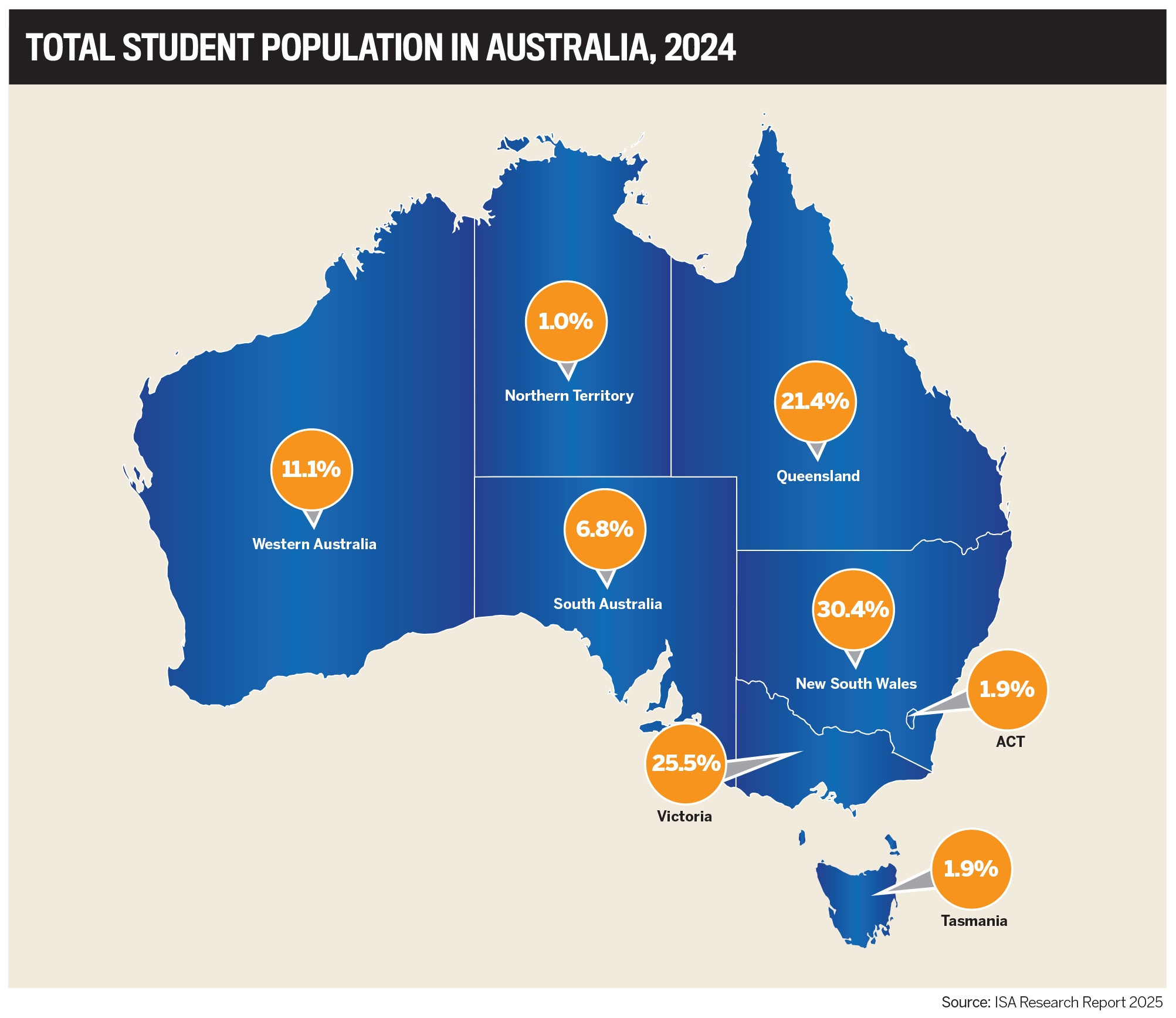
It’s evident among TE’s 5-Star Innovative Schools 2025 that there are many areas to explore.
However, Vince Wall reiterates that mindset is the key to determining success. “Innovation is not a bolt-on; it’s a culture of courageous reimagination.”
And he also lists the key characteristics that define innovative schools:
-
pedagogically agile: moving beyond industrial models of content delivery towards research-informed, human-centred approaches that develop critical consciousness and civic agency
-
not confusing novelty with purpose: integrating emerging technologies not to dazzle but to deepen learning and amplify student agency
-
community of inquiry and belonging: empowering students to think critically, to act compassionately and bravely and to imagine futures worth creating
- Canterbury College (Qld)
- Chevalier College (NSW)
- Clairvaux MacKillop College (Qld)
- Corinda State High School (Qld)
- Galston Public School (NSW)
- Haileybury Pangea (Vic)
- James Fallon High School (NSW)
- Larrakeyah Primary School (NT)
- Lindisfarne Anglican Grammar School (NSW)
- Mancel College (Qld)
- OneSchool Global Berwick Campus (Vic)
- Para Hills High School (SA)
- Ravenswood School for Girls (NSW)
- Redlands (NSW)
- Scotch College Adelaide (SA)
- St Clare’s College Waverley (NSW)
- St John’s Grammar School (SA)
- St Andrew’s Anglican College (Qld)
- Strathcona Girls Grammar (Vic)
- Stretton State College (Qld)
- Stuartholme School (Qld)
- The King’s School (NSW)
- Warrah Specialist School (NSW)
Insights
Over July and August 2025, The Educator invited schools across Australia to participate in the publication’s 5-Star Innovative Schools awards. Now in its 11th year, this report recognises the schools at the forefront of change and innovation.
Entries were open to all educational professionals who believe their school is pioneering a new direction in education. From teaching approaches to learning spaces and curriculum design, the report looks at schools reshaping the future of education.
By the end of the judging process, the entries were narrowed down to 42 of the country’s most forward-thinking schools, which make up TE’s 5-Star Innovative Schools 2025 list.