

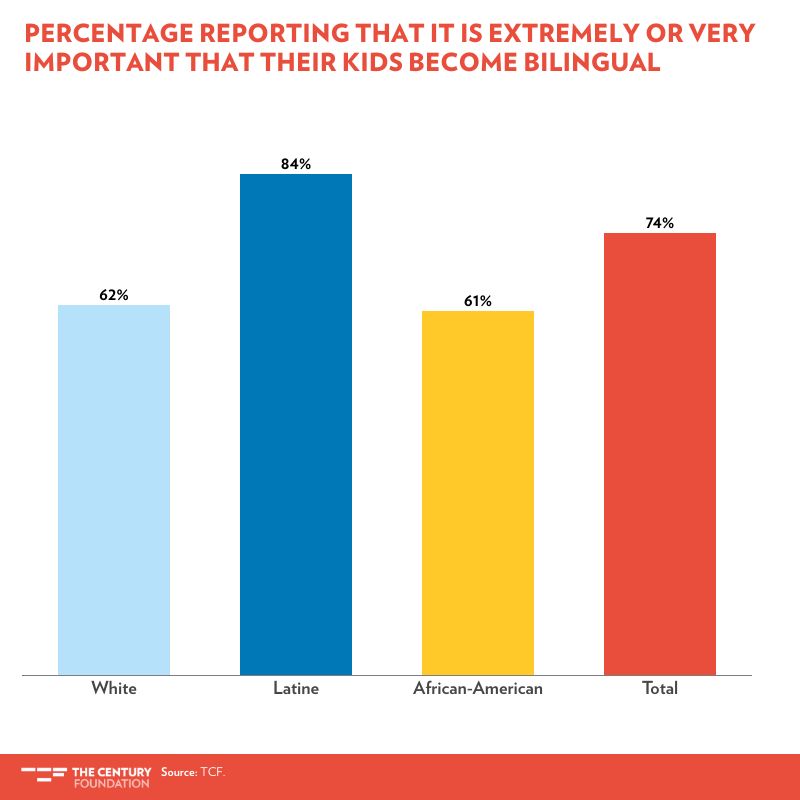
Poll results released by The Century Foundation highlight a significant surge in demand for bilingual education and dual language immersion programs among Latino families in California. The data indicate that Latino parents view Spanish proficiency not just as a cultural asset but as a critical academic and economic tool for their children’s future. The findings contradict a common argument of “English-only” activists that Latino parents and caregivers are mainly concerned about their children learning English.
On average, respondents rated interest in bilingual education at 7.9 out of 10 and interest in dual language immersion programs at 7.8. Interest in these programs was even more pronounced among Latino families and families with higher levels of education and income.
“We can go ahead and put to bed the notion that there is widespread majority support for English-only education amongst Latino communities in California, and I think probably more generally,” based on the latest poll and others, said Conor Williams, the lead researcher and a senior fellow at The Century Foundation.
Implications and Recommendations
Survey and focus group results indicate strong support for bilingualism among families of all backgrounds in California and the US. Across ethnic, linguistic, and socioeconomic groups, large majorities consider bilingualism important for their children’s academic, cognitive, and social development. Recent data highlight that Latine, especially Spanish-speaking, families demonstrate particularly high enthusiasm for dual language education; these families often cite the ability to preserve cultural heritage and improve future career prospects as key motivating factors. Interest is also notably high among socioeconomically privileged families—many of whom seek dual language programs for their perceived academic rigor and global competitiveness—which can help foster integrated, diverse programs but may unintentionally risk excluding English learners (ELs) if enrollment policies are not equitable.
To ensure equitable access to high-quality dual language programs, the report recommends that policymakers:
- Mandate bilingual education in districts where at least 20 English learners (ELs) in a grade share the same non-English home language. This mandate should be paired with increased funding for curriculum development, instructional materials in students’ native languages, and outreach to affected communities to support family engagement throughout program implementation.
- Review and revise teacher licensure requirements to avoid unnecessary barriers to certifying bilingual educators. For example, streamline credentialing processes for teachers already proficient in target languages, recognize out-of-state or international teaching experience, and create alternative pathways for community members and paraprofessionals to become certified bilingual instructors.
- Significantly increase federal funding for ELs and bilingualism, including allocations for program development, classroom resources, ongoing professional development, and teacher training. Prioritize ELs’ access by establishing clear criteria for program eligibility and monitoring enrollment data to identify and address inequities. Additionally, allocate resources specifically for parent outreach, program evaluation, and the creation of culturally responsive curricula.
- Encourage partnerships between school districts, universities, and community organizations to develop pipeline programs for prospective bilingual teachers, facilitate family engagement workshops, and share effective practices across schools.
These comprehensive steps support broad and sustained interest in bilingual education while promoting fairness and effective implementation. By expanding access and investing in quality instruction, states can ensure that all students—including ELs—benefit from the academic and social advantages of bilingualism.
The full report is available here