
Watch above or listen/download below.
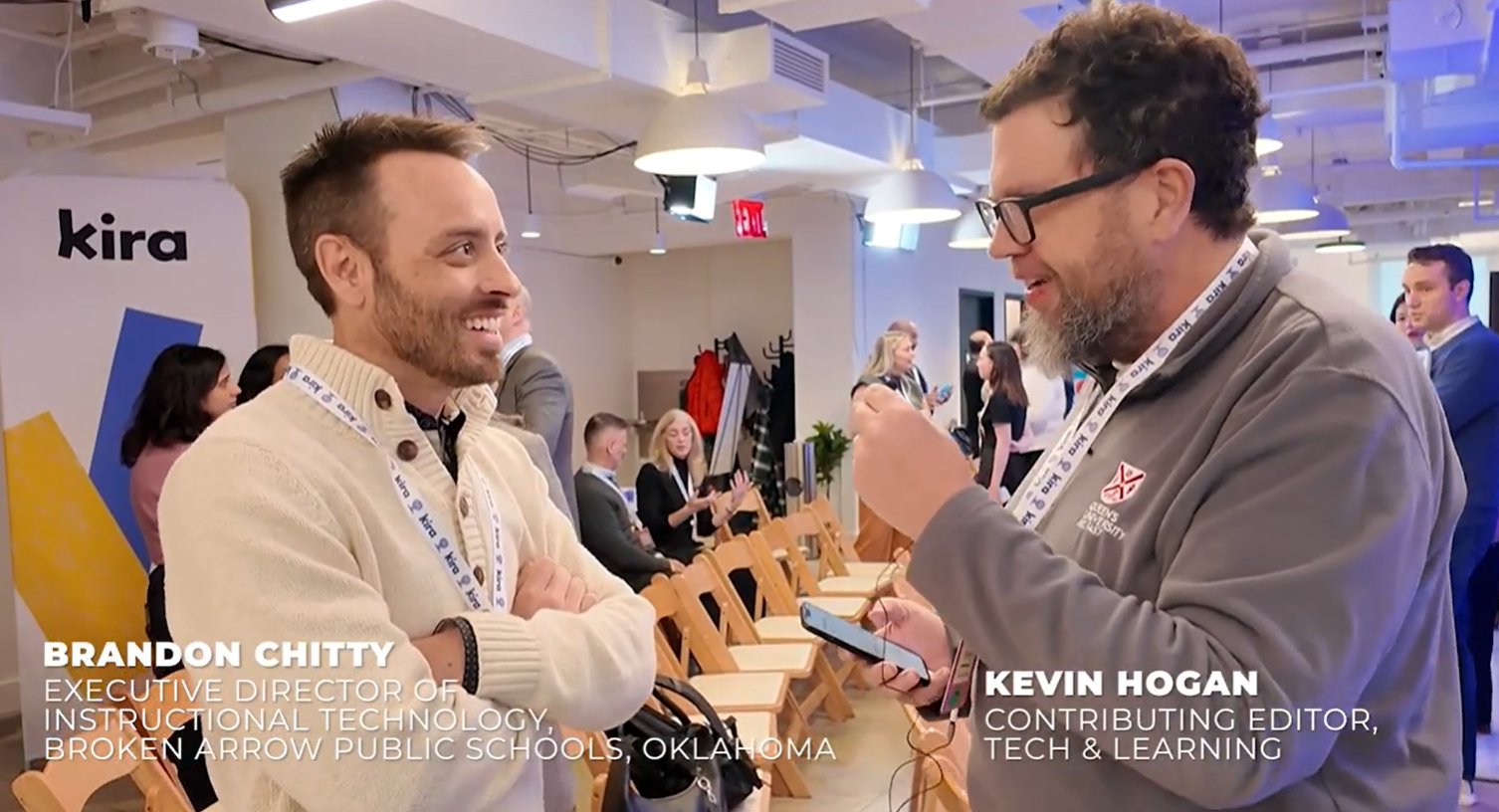
While Zoom calls are great and usually get the job done for our podcasts, nothing beats conversations in person. Recently I got the chance to do just that at the Kira 2.0 launch event held March 3rd in New York City. Company founders introduced what they call an AI operating system for education — a platform designed not to add to the growing list of tools teachers manage, but to replace the need for most of them.
Founded nearly five years ago, Kira has operated largely out of public view, working directly with teachers, students, and administrators to build and refine its platform. The launch marked the first time the company gathered customers, partners, and education leaders to publicly demonstrate what that work has produced.
Article continues below
The centerpiece of the announcement was the Student Atlas, a longitudinal data tool that gives teachers deep, real-time insight into individual student performance — mapping skills, identifying gaps, and generating personalized interventions automatically. The demo showed how a teacher could move from identifying a struggling student to generating a tiered intervention plan, a personalized lesson, and an IEP draft in a matter of minutes.
For Harl Roehm, a computer science teacher from Tennessee who came to Kira through a state-required CS endorsement program, the Student Atlas was the moment that stood out. “I started right about the time they put up the Student Atlas, and I don’t think I quit for two hours,” he said. Previously, Harl had to manually review student responses to identify patterns. “With the Student Atlas, tagging everything through the standards and allowing me to personalize that to each student — that’s going to completely flip the script.”
Brandon Chitty, an administrator from Broken Arrow Public Schools in Oklahoma, was enthusiastic but measured. He sees real promise in the platform’s potential to centralize instruction, but noted that deployment will require strong leadership.
“You have to have powerful leadership of instruction to roll something out like this — one that gives teachers the right amount of agency, but also makes sure that students in Algebra I with one teacher are learning the same thing as students in Algebra I with another,” he said. He also raised the stakes of getting AI literacy right across the board, noting that alternatively certified teachers in particular need structured guidance rather than an open-ended tool.
The platform also includes a Course Studio that uses AI to build full, standards-aligned courses from scratch. During the event, the Kira team showed how eight CTE and AP courses were developed in approximately 30 minutes — a process that one curriculum professional in attendance estimated would traditionally require a team of three people working over three years.
Both educators drew a sharp contrast between Kira and the wave of AI-enhanced tools that have flooded the market in recent years.
“A lot of other companies are an inch wide and a mile deep,” Harl said. “When Kira came on board, it was like, ‘We integrate everything from the beginning.’ For a lot of these other companies, AI was an add-on. With Kira, it’s fundamental to the design.”
Chitty agreed, pointing to the consolidation potential as a long-term differentiator: “In its 3.0 or 5.0 stage, this could eliminate the need for an LMS, eliminate the need for a separate MTSS platform. I’m not tied to any company. I’m tied to student learning.”
Kira also debuted an AI-powered assessment builder with built-in proctoring, grading, and real-time feedback tools that feed directly back into the Student Atlas. The company indicated that a class and school-level rollup of student data, as well as an updated AI tutor, are expected to launch within the coming months.