

Why are diagrams effective?
Diagrams allow us to ‘see the unseeable’. In geography, some students prefer human, as opposed to physical concepts, likely because physical concepts are more abstract, complex, and unfamiliar than human ones – it is far less likely students will have seen an erupting volcano than a wind turbine, for example. Other concepts, such as the carbon cycle, are even more abstract to try to begin to understand, due to the spatial and temporal scales at which these processes operate. Diagrams can therefore be exceptionally useful to make unfamiliar concepts more relatable and understandable both without oversimplifying or overwhelming students (Taylor, 2024)
Cognitive science and diagrams
By learning through diagrams, students select, organise and integrate information, according to Mayer’s SOI model. This final step of integration is essential to ensure information is embedded into long term memory (LTM) and does not become forgotten over time. New information is kept in working memory for a few seconds before it is either forgotten or stored in LTM. How easily information is moved into the LTM is dependent on our pre-existing schemas of knowledge. Reading large passages of text can cause cognitive overload and make it harder for new information to be encoded into the LTM. Using diagrams makes information easier to process: it is therefore more likely for this information to be assimilated into pre-existing schemas and be embedded into LTM.
Two other key cognitive science principles can also help explain why diagrams are particularly useful for effective learning – Mayer’s Cognitive Theory of Multimedia Learning (CTML) and Paivio’s dual coding theory (Taylor, 2024).
According to CTML verbal information is processed sequentially (we hear and process one word at a time) whereas diagrams are processed synchronously, enabling us to take in multiple details and see the ‘bigger picture’ at the same time. This allows students to use different sensory channels to process information, thus aiding learning. Some of CTML’s most pertinent principles of good ‘instructional design’ which are useful to consider when creating classroom diagrams, are:
- Coherence – simplify diagrams to minimise extraneous load (distractions) for students.
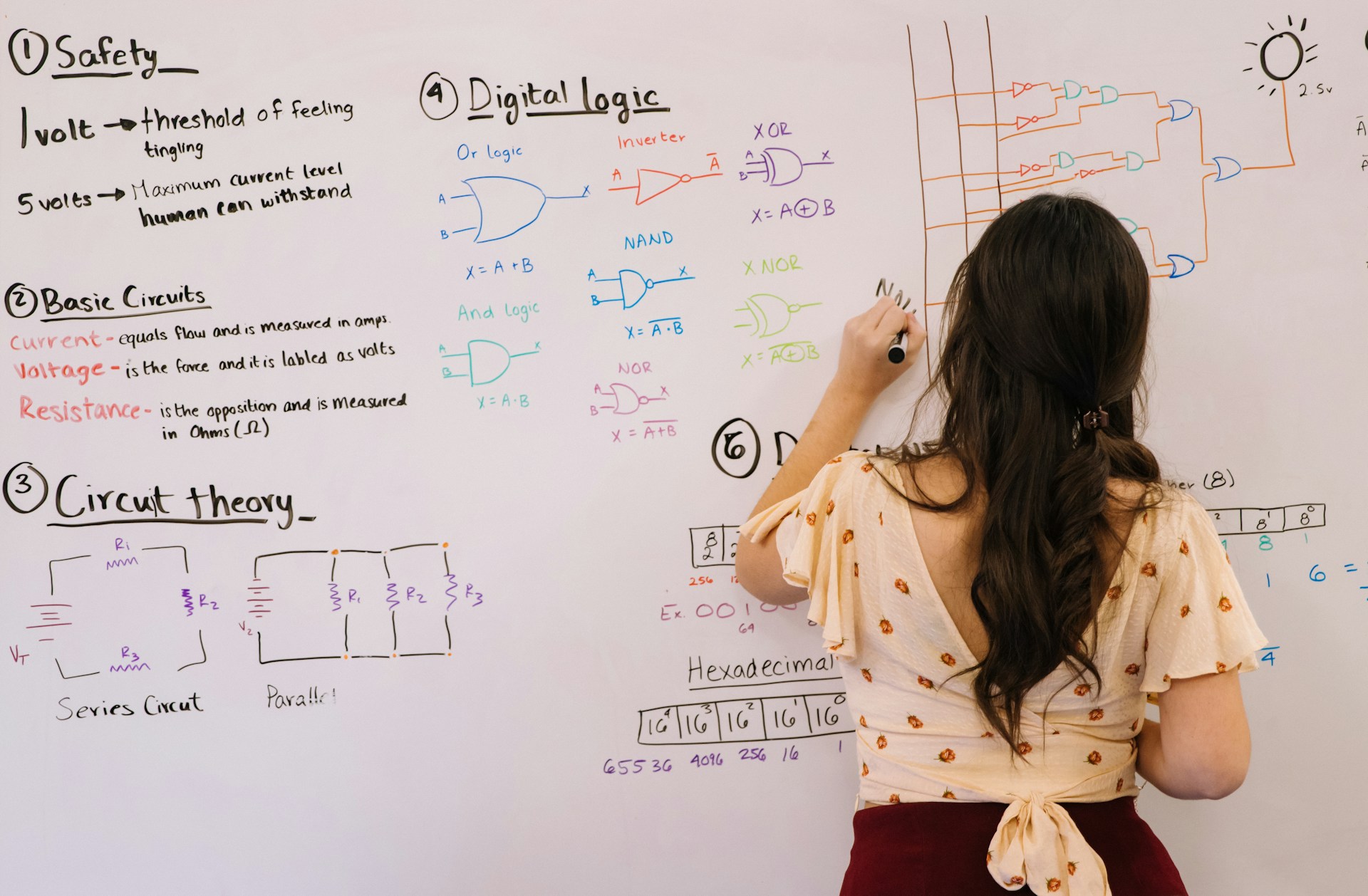
- Signalling – point out specific parts of the diagram to focus on by drawing the diagram step-by-step in front of students.
- Segmenting – breaking down information to have control over the pace of information delivered.
The power of dual coding
The brain has developed two independent (though interacting) storage systems – image memory and verbal memory. If we remember something both as a mental image and a word, a double memory trace is created. Memories will be retained and retrieved more easily if they are stored in two locations in the brain rather than one, as remembering an image or a word stimulates retrieval of the other. Employing this kind of dual coding in diagrams in the classroom helps students’ cognitive load to be reduced and their working memory capacity to be increased, therefore improving learning (Caviglioli, 2019).
Practical examples
Figure 1 – A geographical example of how a teacher might read out information on a slide at the same time as students trying to process the diagram, which is ineffective (Johnstone, 2018).