

Across Australia, schools are increasingly recognising that staff wellbeing is not a peripheral concern, but a central driver of educational excellence. At Northholm Grammar, this understanding has been translated into a distinctive and highly intentional school improvement and staff building initiative, one that stands apart from the growing market of off-the-shelf programs. Designed by the Principal himself, this model ‘Livewell@Northholm’ reflects both a deep engagement with positive psychology and a practical commitment to improving the lived experience of educators.
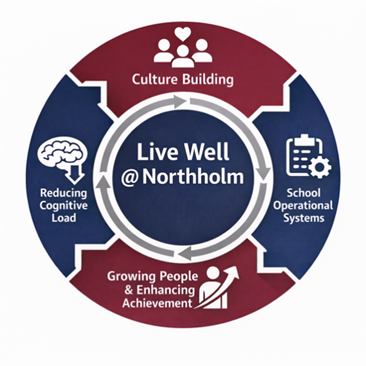
Frustrated by generic staff wellbeing packages that often fail to address the nuanced realities of school environments, the Principal pursued a more contextualised and ‘in the trenches’ solution. Drawing on professional study and leadership experience across multiple schools, he developed a cyclical, feedback-driven framework structured around four key quadrants: culture building, school operational systems, growing people and enhancing achievement, and reducing cognitive load. Together, these elements form a continuous improvement loop grounded in evidence, collaboration, and responsiveness.
At the heart of this initiative is a representative volunteer staff group that meets twice per term. This group provides structured feedback in accord with the four quadrants, surfaces emerging concerns, and contributes ideas for improvement. The Principal then works alongside the senior leadership team to analyse this input and enact targeted reforms across the four quadrants. Crucially, outcomes are communicated back to staff, closing the loop and reinforcing a culture of trust and shared ownership. This ongoing process reflects a genuine commitment, not merely rhetorical, to enhancing the world of their educators.
The first quadrant, culture building, is foundational. Research underpins the importance of relational trust, psychological safety, and shared purpose in schools. Studies by Bryk and Schneider (2002), for example, demonstrate that schools with strong relational trust among staff experience higher levels of collaboration and improved outcomes. Similarly, Edmondson’s work on psychological safety underscores the importance of environments where individuals feel safe to contribute ideas and admit challenges without fear of judgment. Northholm Grammar’s model actively cultivates such a culture by embedding regular dialogue and valuing staff as a driver of change.
The second quadrant, school operational systems, addresses the structures and processes that shape daily work. Inefficient systems are a well-documented source of stress in educational settings. Research in organisational psychology suggests that clarity, consistency, and alignment in systems reduce role ambiguity and increase job satisfaction. By inviting staff to identify friction points within existing processes, Northholm Grammar is able to refine operational systems in ways that are both practical and impactful. This approach aligns with continuous improvement models found in high-performing organisations, where iterative feedback leads to sustained gains in efficiency and morale.
The third quadrant, growing people and enhancing achievement, reflects a commitment to professional and personal development. Evidence from educational research highlights that meaningful professional growth opportunities and opportunities to genuinely achieve Waters (2017) and Seligman (2011) are closely linked to teacher engagement and retention. The OECD has consistently reported that teachers who feel supported in their development are more likely to remain in the profession and demonstrate higher levels of efficacy. At Northholm Grammar, this quadrant is not limited to formal professional learning, but encompasses mentoring, recognition, and pathways for leadership. By positioning growth as a shared priority, the school reinforces a culture of aspiration and support. Already, this has led to the inauguration of a specialised unit within the school dedicated to the cultivation of excellence in teaching and leadership, predicated on an instructional coaching and leadership model aptly named ‘The Northholm Institute for Cultivating Excellence’. There has already been a return on this Principal’s desire for this model to influence educators’ worlds.
The fourth quadrant, reducing cognitive load, is particularly innovative. Teaching is a cognitively demanding profession, with increasing administrative and compliance requirements contributing to overload. Cognitive Load Theory, developed by Sweller (1988), emphasises the limits of working memory and the importance of reducing unnecessary cognitive burden to enhance performance and wellbeing. In recent years, this concept has been applied more broadly to teacher workload, with research indicating that excessive cognitive demands can lead to burnout and reduced instructional quality. Northholm Grammar’s deliberate focus on identifying and eliminating unnecessary complexity—whether in communication, documentation, or task design, represents a forward-thinking application of this research. The first improvement project that has emerged from this thinking was a dedicated forum to exploring a more efficient School Management System (SMS) and integrated Student Information System (SIS). By attending to this larger lever for improving efficiency, many smaller inefficiencies are solved.
What distinguishes this initiative is not only its conceptual clarity, but its authenticity. The Principal’s direct involvement in designing and sustaining the model signals a leadership approach grounded in care, curiosity, and accountability. This is not a delegated program, but a personally invested endeavour with a long-term focus. The structured engagement of staff, the systematic analysis of feedback, and the visible implementation of change in a visible loop all point to a school that is genuinely committed to making staff lives better on the road to educational excellence.
In an educational landscape often characterised by competing demands and limited time, Northholm Grammar offers a compelling example of what is possible when staff wellbeing is approached with intentionality. Its four-quadrant model provides a practical framework to adopt and with its underlying philosophy, that staff wellbeing is both a moral and strategic priority, it resonates broadly.
Ultimately, this initiative reflects a simple yet powerful truth: when school leaders are genuinely engaged in understanding and improving the experiences of their staff, the benefits extend far beyond wellbeing alone. They shape culture, strengthen systems, and create environments in which both educators and students can thrive. Mr Atkinson reiterates ‘Excellence in education starts with people’.