

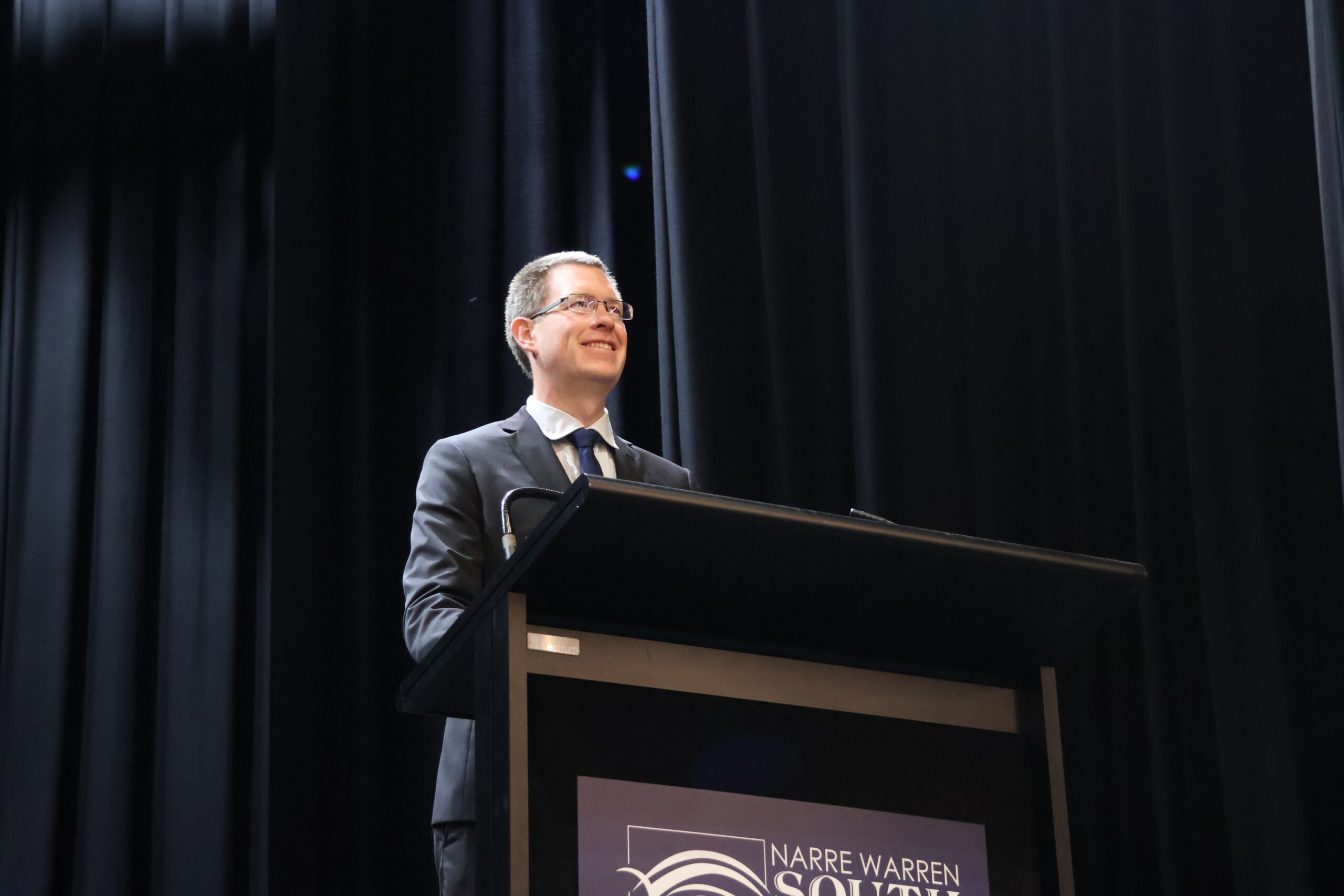
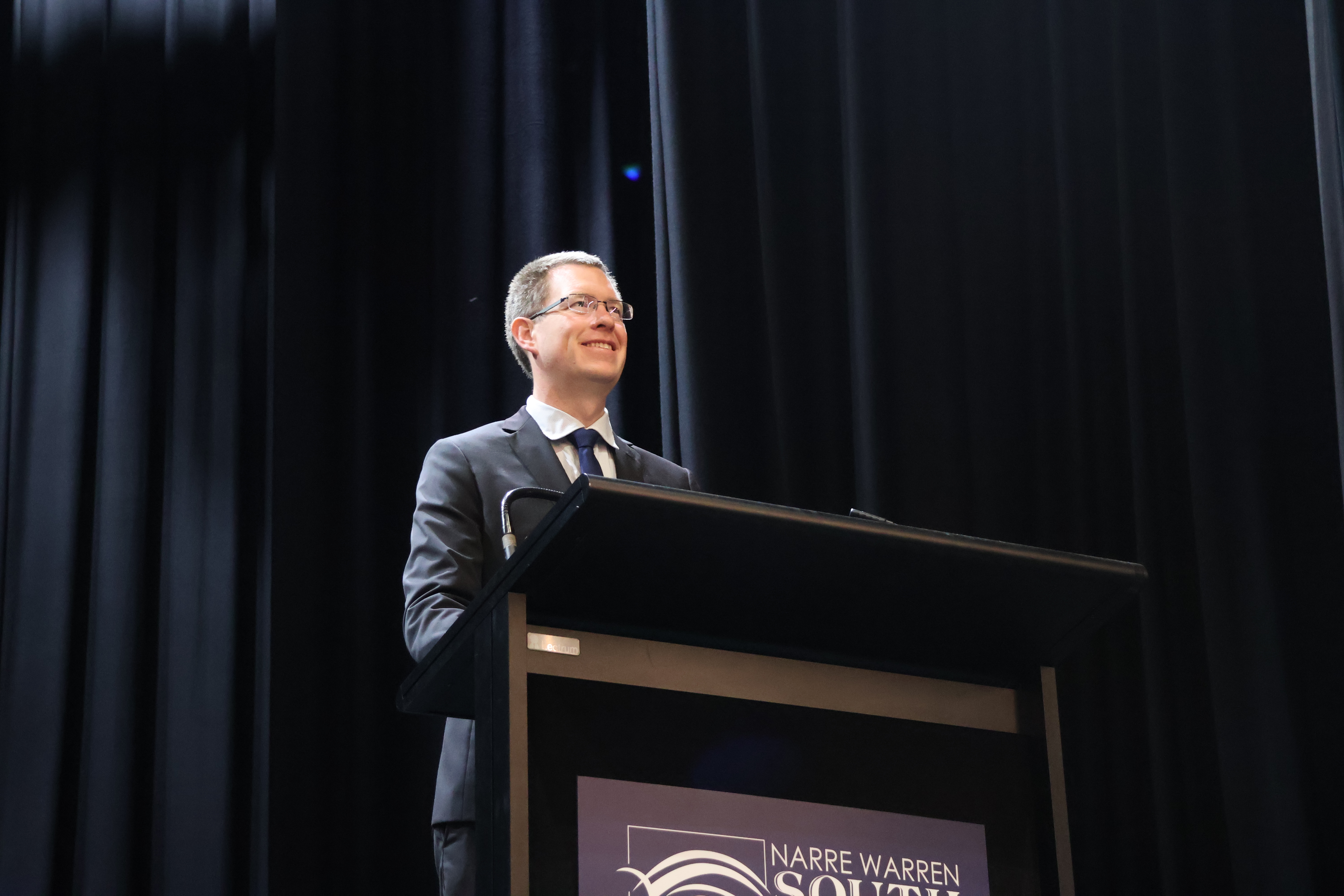
For Lachlan Yeates, the path into school leadership was anything but a straight one.
As an economics graduate and former policy analyst, Yeates’ sights were firmly set on investment banking – until a chance encounter with Teach For Australia at a job fair in Canberra changed everything.
What followed was less a career change and more a calling. As his career took him from classroom to classroom across regional Victoria, Yeates soon found himself not just teaching, but making a real difference in his role – helping young people thrive at school, strengthening teaching practice, and building trust with his students and colleagues.
High expectations, backed by real support
Today, Yeates is Principal at Narre Warren South P-12 College in Melbourne, where his leadership has been shaped by a clear-eyed understanding that the challenges facing students often extend well beyond the classroom – and can’t be solved by teachers alone.
“The challenges students face in lower socio-economic settings often feel far beyond what we can control in the classroom,” Yeates told The Educator. “The challenge is often framed as either accepting that students will achieve lower results or putting a lot of pressure on teachers to solve all the problems facing the young people in their classroom.”
Yeates’ said the school has tried to forge a third way.
“We are resourcing a range of supports for young people and their families that mean teachers can keep their focus on teaching, but young people are able to come to class ready to learn,” he said.
“Once young people are supported in that way, we can apply the same highly effective teaching practices [e.g., explicit teaching] and high expectations that we would with students from more advantaged backgrounds, supporting them to achieve the same outcomes.”
Why networks matter more than ever
Yeates said he learnt a huge amount from being part of the Teach for Australia program – namely classroom coaching; leadership skill development; a strong work ethic; and being able to do university learning alongside teaching to maximise the relevance of it.
“More than anything else though, it was the cohort of incredibly smart, hard-working and morally aligned people I was able to befriend and work with,” he said.
“People I went through the program with are now teachers, principals, EdTech entrepreneurs, consultants, members of parliament and researchers. I have been humbled by their ability to connect me with research and best practice that I am able to put directly into practice in the schools I work in.”
A focus on teaching, not ticking boxes
At Narre Warren South P-12 College, Yeates is driving school improvement by lifting students’ NAPLAN results and school attendance. He said “being surrounded by a wonderful team of educators” has contributed to this success.
“Every day I am amazed by the teachers and school leaders who turn up every day with a smile on their face and love in their hearts to do the hard work of ensuring every child can achieve their best,” he said.
“The first and most important thing I do when starting in a new school is to remove any bureaucratic busy work that keeps educators from doing what matters most.”
Yeates said that includes making sure the school only collects data it will use; creating a strong and explicit curriculum that saves teachers planning time; always backing teachers when working with challenging parents; and developing strong whole-school routines and expectations to support positive student behaviour.
“Once we’ve done that, teachers can do amazing work.”
The second initiative, says Yeates, is Evaluative Thinking.
“This describes the way school leaders are clear on what they want to improve, find strong, evidence-based approaches to improving them, and closely track implementation to make adjustments if needed,” he said.
“That is the meta-initiative that has led to teaching approaches such as phonics, explicit instruction and trauma-informed practices that maintain high student expectations.”
Purpose-driven leaders rising through the ranks
Teach For Australia CEO Edwina Dohle said many Alumni are not only stepping into leadership roles but doing so with a strong sense of purpose and a clear understanding of the complexities those roles involve.
“Our recent Alumni Impact Report found that 2 in 3 Alumni working in schools hold leadership positions within 5 years of completing the Leadership Development Program [LDP], significantly outpacing the national average of less than 1 in 3,” Dohle told The Educator.
“Through Teach For Australia’s LDP, leadership potential is identified early and deliberately strengthened over time. Leadership is a core selection competency from the outset, and throughout the two-year program, Associates build the capability and determination needed to lead schools.”
Dohle said TFA is also seeing that its participants are deeply motivated by educational equity and opportunity, which gives them a strong foundation for leadership that is both values-driven and practical.
“Ultimately, our Alumni’s progression into leadership roles reflects the quality of their work and the confidence that schools place in them.”
Building resilience in high-pressure classrooms
A growing number of surveys are showing that retention alone doesn’t always solve the issue of Principal and teacher burnout.
When asked what specifically TFA is doing differently that helps these teachers stay well and sustainable in high-pressure school environments, Dohle pointed to a more holistic approach to support and development.
“Retention is a key part of ensuring a sustainable education system, but principals are right to point out that staying in the profession is not the same as staying well,” Dohle said.
“We know burnout is driven by a range of factors, including workload pressures and a lack of reward or recognition. While it is pleasing to see governments rightly focused on addressing these issues, it is undeniable that teaching can be a demanding profession, particularly in complex school contexts.”
Dohle said burnout is less likely when teachers feel clear about what is expected of them, supported by the people around them, connected to purpose, and able to see the impact of their work.
“That is where Teach For Australia offers something distinct,” she said.
“Alongside developing participants’ knowledge and teaching skills, our programs ensure they have a deep understanding of their students, the education systems they operate within, and their personal capacity to make a meaningful difference.”
Dohle said TFA implements structured steps and goals to guide teachers’ early practice, along with providing coaches and supports that give regular feedback and advice to participants on what success looks like.
“We also work to build a strong cohort experience and forge friendships, so that early career teachers can draw support from peers navigating similar challenges in other schools,” she said.
“We believe this combination matters. Our recent Alumni Impact Report found more than 70 per cent of Alumni are still teaching five years after completing the program, with more than two in three Alumni holding leadership positions within five years of graduating.”
Dohle said the key lies in getting the foundations right.
“In a climate where schools are grappling with workforce challenges, that tells us a strong values-alignment with educational equity, strong preparation and consistent support can make a genuine difference to whether teachers not only stay but continue to grow.”
Pro tip: Build middle leaders or risk burnout
Dohle said that while Principals do an “extraordinary job and make a profound difference” in their school communities, they should not be expected to carry the full weight of leadership alone.
“From what our Alumni tell us, one of the challenges in school leadership is that too much responsibility can still sit with too few people, which places significant pressure on individuals and can make the role harder to sustain over time,” she said.
“That is why we think there is a real need to keep building leadership capability in schools, so principals are supported by the teams around them.”
Dohle said thriving schools are built by people at different levels taking responsibility for culture, teaching and learning, and school improvement.
“If we want a stronger and more sustainable leadership pipeline for the future, there needs to be greater focus on developing middle leadership within schools,” she said.
“Building capability at this level strengthens leadership teams in the short-term, while also creating a clearer pathway for the next generation of school leaders.”
There is also a broader question about flexibility, Dohle noted.
“If we want leadership to be sustainable and attractive to the next generation, we need to think carefully from a policy perspective about how these roles are designed, how responsibility is shared, and how schools can create more flexible ways of working that reflect the realities of modern professional life,” she said.
“What we also hear, though, is that notwithstanding these challenges, there are still really encouraging stories coming through from schools.”
Dohle said TFA Alumni talk about the positive progress they’re seeing in their schools, from lifting attendance rates and improving NAPLAN results to delivering literacy and reading initiatives in regional and remote schools.
“It’s a reminder that school leaders and teachers are making a tangible difference every day, and that our policy settings and systems must support the conditions that allow them to do their best work.”