
Alexandra Güílamo suggests how dual language program leaders can best integrate science of reading legislation

Literacy is the right of every child, and our target must be literacy rates of 100%. However, how best to realize that goal continues to be debated by districts across the country, giving states good reason to take action. In the last ten years, early literacy policies and science of reading (SOR) mandates have swept the nation, aiming to enact much-needed literacy reform. Between 2013 and 2025, over 200 policies (Schwartz, 2022) were passed nationwide, with the vast majority of states joining the charge in 2023. While nuanced from state to state, most mandates include requirements around (pre)teacher professional learning, assessment and screening, and the use of evidence-based curricular materials (those with clear alignment to cognitive science). And, with much debate, many states have included third-grade retention mandates for students not yet reading at grade level.
While well-intentioned, these mandates have created a litany of disconnects for leaders of dual language education (DLE) programs across the country. How are they to implement literacy curricula that have only been aligned to cognitive science when effective instruction in these contexts requires the complex weaving of so many bodies of research and evidence (e.g., neurocognitive functions and diversity, metalinguistics and human development, bilingualism and dynamic transfer, language development, applied linguistics, etc.) (Guilamo, 2021)? And how are DLE teams supposed to collaborate when the teacher responsible for English literacy and English language development is part of professional learning that prescribes a singular approach to reading that leaves no space for language development? But what’s driving DL educators to the fear-based response of deprioritizing their partner language is the mandate to retain third graders who are not yet reading on grade level in English. It is an expectation that defies much of the research we have on language-development trajectories (Thomas and Collier, 2002), and by extension English literacy success.
It can be difficult to navigate the space between relatively new literacy mandates and doing what is good and right by DLE students. Yet the answer lies somewhere in between. We do not have the luxury of choosing programs of equity and access, biliteracy and bilingualism, and academic achievement in two or more languages (Berman et al., 1995; de Jong, 2011; Genesee et al., 2006; Lindholm-Leary, 2001; Lindholm-Leary and Genesee, 2010; Montecel and Cortez, 2002), or following early literacy mandates and legislation. Yes, DLE programs must attend to phonemic awareness, phonics, vocabulary, fluency, and comprehension as essential components of literacy instruction (NICHD, 2000). However, they also need space for oracy, transfer, writing, and the distinct but interconnected worlds of language comprehension and reading comprehension by leveraging the science of the bilingual reading brain (bilingual SOR) (Guilamo, 2021). We need both. The viability and success of DLE programs will surely be shaped by the choice not to include the two.
DLE leaders are making the choice to do this by taking actions that include and go beyond the mandates. First, they receive support from DL experts on how to navigate new evidence-based curricula across languages, minutes, practices, and standards, as well as how to coordinate both partner languages into a single biliteracy scope and sequence. Second, these districts use cross-departmental collaboration to build coherence across monolingual literacy and biliteracy structures and expectations. Third, they invest heavily in DL-specific capacity-building across the many strategic partnerships, educational roles, assessment and data systems, and existing structures for continuous learning. Lastly, they know what their states’ policies and mandates do and do not say, in order to know the flexibility they have and what advocacy efforts are still needed.
First, our partner districts learned that while they had to implement new evidence-based curricula, they needed support from DL experts on how to navigate those resources across languages, instructional minutes, DL practices, and standards. Their need to provide direct, explicit, and systematic instruction in foundational skills didn’t change their choice to coordinate this instruction across both partner languages. Finding this balance shaped the partnership in Summit, Illinois, where DLE staff could not ignore the disconnects between foundational skills being taught in each language. The Spanish foundational skills scope and sequence was disjointed from its English counterpart, and the total number of minutes required to teach these skills across both languages far exceeded the daily recommended amount (about a quarter, or 20–25%, of the standard two-hour block in an early literacy program) (Shanahan, 2013). When faced with the option of keeping these two worlds isolated from one another, the choice was clear. Why make teachers and students work harder than research, evidence, and standards intended? So, the district began aligning both resources into a singular biliteracy scope and sequence that provides a clear staircase of learning between Spanish and English. This DL-specific scope and sequence have left more time to explicitly teach opaque skills, like English’s many vowel combinations. This approach has also created the conditions for amazing transfer, contrastive analysis, connection to language comprehension, and bilingual SOR practices. By pairing shared alphabetic principles, letter–sound relationships, syllabic patterns, and more across partner languages into a single biliteracy scope and sequence, teachers maximize their instructional time rather than reteaching learning that students already know.

Second, our partner districts use cross-departmental collaboration to build coherence across monolingual literacy and biliteracy structures, while also incorporating district-wide expectations. In MSD of Lawrence, Indiana, legislation to provide capacity-building and a systematic approach to foundational skills guided how we brought coherence to the partnership. All DLE pre-K–3 teachers were provided with five days of professional learning that was distinct from monolingual teachers’. After each day of professional learning, job-embedded coaching provided teachers with safe practice and application. This added layer of support helped the district implement bilingual SOR effectively. The implementation included all components of their literacy legislation. More importantly, this DL-focused learning also addressed those areas that lacked attention in the legislation—namely, oracy, writing, transfer, and language development. These areas weren’t ignored in MSD of Lawrence simply because they were not mandated, since these components were still vital to the effectiveness of biliteracy instruction.
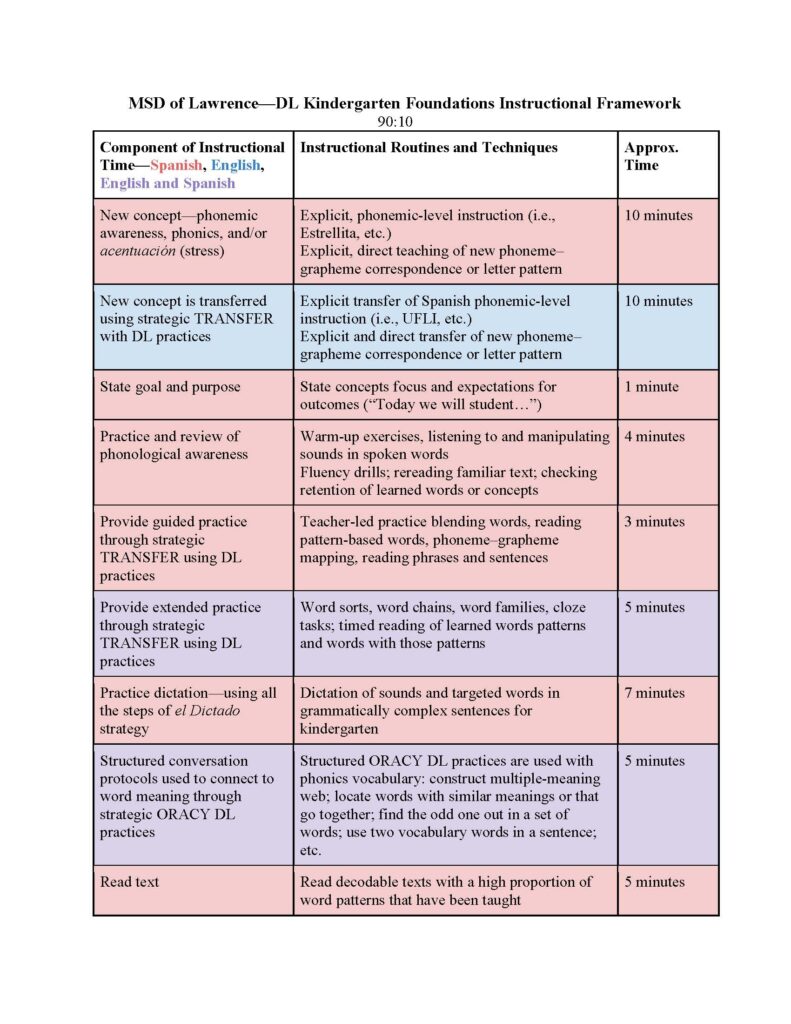
Equally important was the collaboration with building and district leaders. DLE building leaders engaged in learning, strategic planning, and goal-setting support to identify the immediate shifts that needed to be priorities for their DLE buildings. And leaders from the Multilingual, Literacy, and Elementary departments collaborated on aligning systems so that bilingual SOR could thrive in DLE classrooms. This partnership made space for much-needed guidance and tools highlighting how the components of their district-wide structured literacy approach (IDA, 2021, 2023) aligned within and across both program languages. This guidance was key to avoiding the common DLE pitfall of having students endure 60+ minutes of isolated foundational skill instruction (30 minutes in English, 30 minutes in the partner language, and 30 minutes of a pull-out intervention) (Shanahan, 2013). This collaboration also helped the structured literacy approach serve as a coherent framework across monolingual literacy and biliteracy expectations that went beyond literacy legislation in DLE programs.
Third, our partner districts invest in listening to DLE data to determine capacity-building efforts across the many educational roles and existing systems for continuous learning. Jefferson Parish, Louisiana (New Orleans area), is a prime example of this. Their capacity-building journey has included bilingual SOR, backwards planning, and targeted job-embedded DLE teacher and leadership coaching. This support led to DLE students outperforming students who receive literacy instruction in the general education setting in many DLE buildings. When this data was transparently shared, the district chose to capitalize on the success. The Multilingual and Teaching and Learning departments collaborated to form DL-specific professional learning communities (PLCs) (DuFour et al., 2010) and targeted coaching for DL leaders (Castellano et al., 2002). DL-specific leadership PLCs analyzed program integrity, biliteracy, and bilingual language data. They created program, biliteracy, and academic growth goals in both languages. Continuous improvement plans were monitored and adjusted throughout the year. It made PLCs an incredible vehicle for even more student growth and for every DLE program in JPS to be certified by the state of Louisiana in 2026.
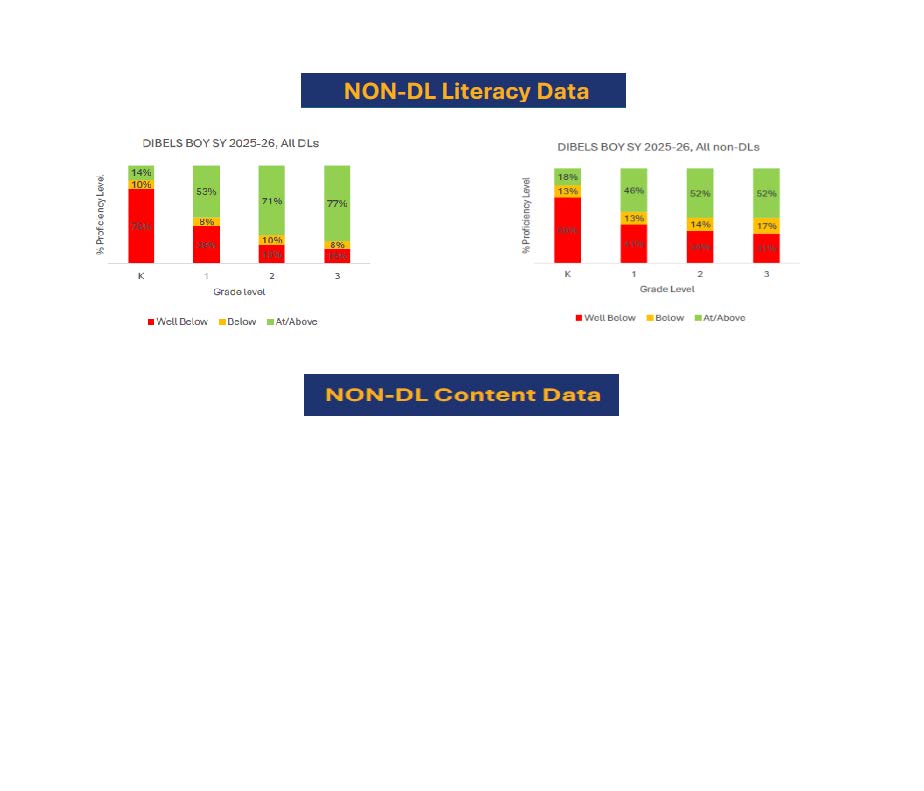
Recognizing literacy reform as an immensely large-scale change effort, Jefferson Parish continued to ensure coherence across other roles and systems for continuous learning. District-level departments and content leaders came together to learn about critical aspects of DLE programming and key strategies for biliteracy success. Master teachers who facilitate building-based PLCs and coaches were provided with DL-specific professional learning. This learning went beyond the mandates to include essential components, like bilingual SOR implementation and backwards planning for integrated literacy-based ELD. Again, they listened to data to ensure this learning was powerful—so much so that some master teachers have begun introducing such strategies as el Dictado (Escamilla et al., 2014) to spaces outside of the DLE program.
Lastly, our partner districts know their states’ policies and mandates, what flexibility they have, and what advocacy efforts are still needed. In Lynn, Massachusetts, professional learning, job-embedded coaching, PLCs, and an integrated biliteracy scope and sequence have been critical aspects of their journey. This district has also leaned into the assessment and screening requirements of their early literacy policies. Access to native-language literacy assessments is provided to Spanish-speaking students outside the DL program to ensure equitable response systems building-wide. Pairing this information with language and content data offers critical insight for a more accurate teacher response.
Next, parallel literacy assessments (Butvilofsky, 2020) were leveraged in DLE. This holistic view of biliteracy allowed for flexible grouping between partner language teachers so that students are supported in the language that is most appropriate for them. What’s more impressive is that biliteracy data and bilingual writing samples have made way for structures like “Transfer Tuesdays” and small groups focused on translanguaging in writing. These DLE leadership teams and teachers have gone beyond mandated assessments to shape practices that are vital to DLE biliteracy success.
Advocacy runs deep in Louisiana, which was once home to the greatest opportunity and achievement gap between monolingual and emergent bilingual/DLE students in the country (MEEP, 2018). Joint efforts between advocates, districts, and agencies led to significant transformation of their high-stakes testing approach. Third graders and beyond can now show a more accurate picture of their literacy abilities by leveraging translanguaging in their responses on state testing (DESE, 2026). This means that students can use a combination of Spanish and English to more fully express what they know and are able to do. This shift is powerful. It is a chance for students to show literacy knowledge through bilingual brilliance rather than within the bounds of their development in any one language. This shift is also less likely to produce the fear-based response of deprioritizing a partner language, which weakens the integrity and success of the program as a whole.
These districts are just some of the examples of the shared vision for DLE to create equity and access to an educational model that uses the very best research and evidence for the students who have been entrusted to our care. This vision cannot disappear when implementing literacy legislation. Rather, I urge every DLE leader to stand firm in your why as you consider this quote.
“Two roads diverged in a wood, and I—
I took the one less traveled by,
And that has made all the difference.”
Robert Frost
Decades ago, the road less traveled may have been DLE programs, but that is no longer the case—from 2,500 two-way DL programs in 2018 (Arias, 2018) there are now nearly 5,000 DL and immersion programs across the country (https://duallanguageschools.org). DLE is no longer a road less traveled, nor is it an island. It cannot thrive with research on DLE and bilingualism alone—not under the weight of literacy legislation. The less-traveled road now involves making sure DLE excellence and SOR implementation are not adversaries but partners. It is a partnership that requires collaboration, shared strategic planning, interpreting policies more critically, and creating coherence across the entire educational system so that we don’t go back to the meager monolingual outcomes that we have experienced before (Collier and Thomas, 2004).
References
Arias, M. B. (2018). “Preface.” In M. B. Arias and M. Fee (Eds.), Profiles of Dual Language Education in the 21st Century, pp. xiii–xviii. Bristol, UK: Multilingual Matters.
Buckingham, J., Beaman, W. R., and Wheldall, K. (2019). “Systematic and Explicit Phonics Instruction: A scientific, evidence-based approach to teaching the alphabetic principle.” In R. Cox, S. Feez, and L. Beveridge (Eds.), The Alphabetic Principle and Beyond (pp. 49–67). Newtown, NSW: Primary English Teaching Association Australia.
Butvilofsky, S. A., Escamilla, K., Gumina, D., and Silva Diaz, E. (2020). “Beyond Monolingual Reading Assessments for Emerging Bilingual Learners: Expanding the understanding of biliteracy assessment through writing.” Reading Research Quarterly, 0(0), 1–18.
Castellano, M., Stringfield, S., and Stone, J. R., III. (2002). Helping Disadvantaged Youth Succeed in School: Second-Year Findings from a Longitudinal Study of CTE-Based Whole-School Reforms. National Dissemination Center for Career and Technical Education, Ohio State University.
Collier, V., and Thomas, W. (2004). “The Astounding Effectiveness of Dual Language Education for All.” NABE Journal of Research and Practice, 2(1), 1–20.
de Jong, E. J. (2011). Foundations for Multilingualism in Education: From Principles to Practice. Caslon Publishing.
DeMatthews, D., Izquierdo, E., and Knight, D. (2017). “Righting Past Wrongs: A superintendent’s social justice leadership for dual language education along the U.S.–Mexico border.” Education Policy Analysis Archives, 25(1), 1–32.
DualLanguageSchools.org. (2026). “Find Dual Language Schools by State.” https://duallanguageschools.org
DuFour, R., Eaker, R., and Many, T. (2010). Learning by Doing: A Handbook for Professional Learning Communities at Work (2nd ed.). Solution Tree.
Escamilla, K., Hopewell, S., Butvilofsky, S., Sparrow, W., Soltero-González, L., Ruiz-Figueroa, O., and Escamilla, M. (2014). Biliteracy from the Start: Literacy Squared in Action. Caslon Publishing.
Genesee, F., Lindholm-Leary, K. J., Saunders, W., and Christian, D. (2006). Educating English Language Learners. Cambridge University Press.
Güílamo, A. S. (2021). “The Science of Reading in Dual Language.” Language Magazine. www.languagemagazine.com/2021/04/20/the-science-of-reading-in-dual-language/?fbclid=IwAR2c0NHbPV4PX-RkXA01x1_Pl4kTTu9igethjR5YzWg1HzpDD1I7cS5fM_U
International Dyslexia Association. (2021). “Structured Literacy: An introductory guide.” Educator Training Initiatives Brief. https://app.box.com/s/mvuvhel6qaj8tghvu1nl75i0ndnlp0yz
International Dyslexia Association Ontario Branch. (2023). “Effective Reading Instruction.” www.idaontario.com/effective-reading-instruction
Lindholm-Leary, K. J. (2001). Dual Language Education. Clevedon, England: Multilingual Matters.
Lindholm-Leary, K., and Genesee, F. (2010). “Alternative Educational Programs for English Language Learners.” In California Department of Education (Eds.), Improving Education for English Learners: Research-Based Approaches (pp. 323–382). CDE Press.
Massachusetts Department of Elementary and Secondary Education. (2026). Accessibility and Accommodations Manual for the 2025–26 MCAS Test Administrations: Including Participation Requirements for Students with Disabilities and English Learners, December 2025. www.doe.mass.edu/mcas/accessibility/manual.pdf
Massachusetts Education Equity Partnership. (2018). “Number One for Some: Opportunity and achievement in Massachusetts.” https://masseduequity.org/wp-content/uploads/2023/08/Number-1-for-Some-9.25-18.pdf
Montecel, M. R., and Cortez, J. D. (2002). “Successful Bilingual Education Programs: Development and the dissemination of criteria to identify promising and exemplary practices in bilingual education at the national level.” Bilingual Research Journal, 26, 1–21.
National Institute of Child Health and Human Development, NIH, DHHS. (2000). Report of the National Reading Panel: Teaching Children to Read: An Evidence-Based Assessment of the Scientific Research Literature on Reading and Its Implications for Reading Instruction (NIH Publication No. 00-4769). US Government Printing Office. www.nichd.nih.gov/publications/product/24
Schwartz, S. (2022). “Which States Have Passed ‘Science of Reading’ Laws? What’s in Them?” Education Week. www.edweek.org/teaching-learning/which-states-have-passed-science-of-reading-laws-whats-in-them/2022/07
Shanahan, T. (2013). “How Much Time Should We Spend on Comprehension and Phonics?” Shanahan on Literacy. www.shanahanonliteracy.com/blog/how-much-time-should-we-spend-on-comprehension-and-phonics
Thomas, W. P., and Collier, V. P. (2002). A National Study of School Effectiveness for Language Minority Students’ Long-Term Academic Achievement. Center for Research on Education, Diversity, and Excellence.
Alexandra Güílamo is a dual language expert, author, keynote speaker, and the chief equity and achievement officer at TaJu Educational Solutions (a company dedicated to professional development, coaching, and technical support for DL and bilingual programs). Visit www.tajulearning.com or follow Alexandra @TajuLearning on Twitter, Facebook, and Instagram.