

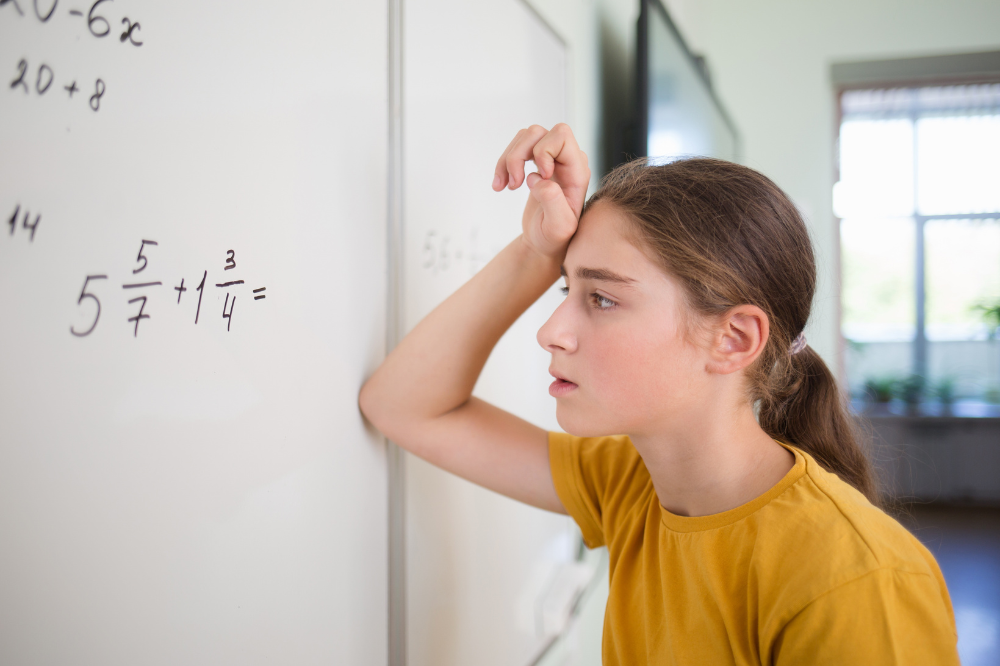
Boys are increasingly pulling ahead of girls in mathematics outcomes, particularly by the end of primary school, new global research shows.
Drawing on TIMSS results from 1995 to 2023, the findings – contained in a new research brief, ‘Girls Losing Ground: The Widening Gender Gap in Mathematics – show widening gaps at both the top and bottom ends of achievement.
The research brief, published by the International Association for the Evaluation of Educational Achievement (IEA) in partnership with UNESCO, uses data from countries and territories that took part in the Trends in International Mathematics and Science Study (TIMSS) assessments from 1995 to 2023 (47 countries and territories for fourth grade and 38 for eighth grade), including Australia, the United States and England.
The data shows that boys significantly outperformed girls in mathematics in fourth grade in 81% of the surveyed countries, compared to 52% in 2019 and 39% in 2015.
A staggering 85% of countries showed a significant overrepresentation of boys reaching the advanced international mathematics benchmark in fourth grade, while 21% of countries had a significantly higher proportion of girls failing to reach the low international mathematics benchmark in fourth grade, compared to 4% in 2019 and 2% in 2015.
International researchers have been aware of a gender gap in maths for decades and have been trying to understand why and how to fix it.
It has previously been suggested boys are just better at mathematics than girls. However, this has been thoroughly debunked, with many studies finding no statistically significant biological difference between boys and girls in maths ability.
Maths gap driven by confidence, not capability
In general, the achievement gap between girls and boys in mathematics is explained by their learning experiences rather than ability, said Mathias Eck, Programme Specialist in UNESCO’s Section of Education for Inclusion and Gender Equality.
“These differences are shaped by a range of factors, including persistent gender stereotypes, teacher expectations and classroom interactions,” Eck told The Educator. “Girls often report lower confidence in mathematics, which influences their engagement, participation and persistence in the subject.”
Eck said this is closely connected to students’ mathematical self-belief and confidence as well as their participation in mathematical activities both inside and outside the classroom.
“Together, these factors can influence how girls and boys engage with mathematics over time, shaping confidence, achievement and longer-term learning pathways,” he said, adding that the reversal of progress observed earlier may partly reflect the lingering effects of the COVID-19 pandemic.
“Evidence from the Trends in International Mathematics and Science Study 2023 and other international assessments indicates that longer school closures were associated with greater learning losses in mathematics, with girls often experiencing larger declines or slower recovery.”
UNESCO’s report found that while findings vary across contexts, pandemic-related disruptions may have exacerbated existing disparities and reduced learning opportunities for girls, particularly those at risk of low achievement.
“In addition to academic effects, the pandemic may have amplified non-cognitive barriers,” he said.
“Prolonged disruptions to in-person learning and decreased teacher or peer interaction may have further undermined girls’ confidence and engagement, underscoring the need for recovery measures that rebuild self-belief and motivation alongside academic support.”
Female role models can shift the dial
The report laid out four main recommendations to bridge the divide in boys’ and girls’ maths outcomes, urging education systems to build girls’ maths confidence early, train teachers to tackle bias, track progress through gender data, and actively challenge stereotypes to lift participation in STEM.
Beyond this, Eck said that training teachers in gender-transformative pedagogy can make a meaningful difference.
“Gender-transformative pedagogy means equipping teachers to identify and address gender bias and promote equitable classroom interaction and participation in mathematics, but also to empower girls in mathematics by building their confidence and to challenge stereotypes on girls and mathematics,” he said.
“Moreover, teachers can promote active, cooperative learning that promotes problem-solving, peer interaction, and learning from mistakes in low-pressure settings. These have been shown to reduce gender gaps in mathematics.”
Eck said exposure to female role models raises aspirations and engagement by providing visible successful examples and breaking down stereotypes.
“Teachers can invite female role models in mathematics in their classes.”
Scaling proven teaching models key to parity
UNESCO is leading a regional initiative in Latin America and the Caribbean to promote girls’ participation and performance in science, technology, engineering and mathematics (STEM) through gender-responsive mathematics pedagogy.
In partnership with the UNESCO Chair of Pedagogy in Mathematics (University of Chile), Ministries of Education, and teacher training institutions, the initiative identifies and disseminates effective teaching practices, builds capacity among teacher educators, and curates a regional repository of promising approaches.
Eck said good practices can be scaled and become an integral part of an education system promoting gender equality in and through education.
“UNESCO actively engages with emerging, inclusive approaches to mathematics education,” he said.
“For example, the ‘Maths Through Stories’ methodology, which integrates storytelling and problem solving to enhance engagement, particularly among girls, was the focus of a training workshop held in the Maldives in 2025, supported by UNESCO, and delivered by the creators at the University of Reading, in partnership with Maldives National University.”
Eck said this workshop led to the development of an action plan for piloting the approach in local schools.
“The methodology has shown promise in resource constrained contexts for improving pedagogical inclusivity and gender responsiveness.”