

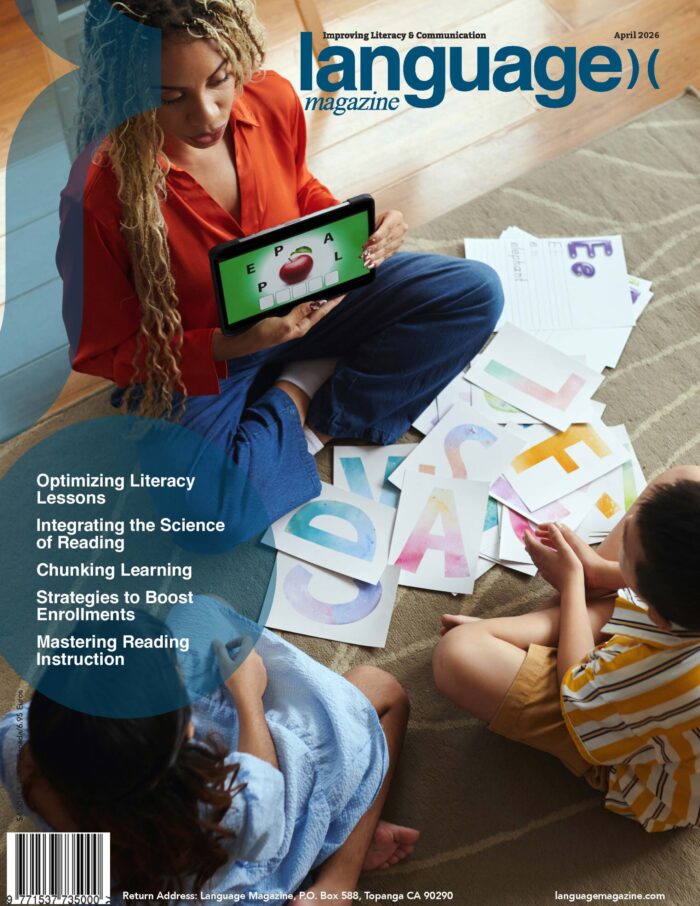
Daniel Ward sets Multilingual Learners at the center of efforts to improve reading scores
Despite the administration’s arguments to the contrary, ensuring that multilingual learners (MLs) are central to the success of national literacy efforts may become more difficult now that the controversial structural changes to the Department of Education are set for implementation next month.
The most obvious change is that the Office of English Language Acquisition (OELA) will be dissolved and its functions will be redistributed across the Office of Elementary and Secondary Education (OESE), already undermined by mass firings last October in the midst of a government shutdown. The reasoning behind its closure is that a standalone office is no longer “needed.” Such a rationale can only be based on the belief that minority learner groups are catered for adequately and fairly by the public school systems operated by the states, so English learners do not need specialist attention to succeed. Having said that, the National Clearinghouse on English Language Acquisition (NCELA) will remain intact under OESE.
As for funding, the good news is that there has been a commitment to Congress that Title III-A SEA grants will be distributed by July 31 and preliminary allocations have already been sent to State Educational Agencies (SEAs). However, responsibility for the program will be relocated to the Division of State Support and Accountability (SSA), which lacks the expertise to oversee a specialized grant program designed to help MLs meet challenging state standards.
To further diminish the Department of Education, the Native American and Alaska Native Children in School Program will move to the Office of Indian Education, while National Professional Development (NPD) Discretionary Grants will move to the Office of Effective Educator Development Programs (OESE) (within an interagency structure with Department of Labor), where a decision on a potential NPD competition is expected imminently.
In her notification of these changes to members of the congressional Committees on Health, Education, Labor, and Pensions, Mary Christina Riley, assistant secretary for legislation and congressional affairs, claims that “moving these programs to other offices will better streamline and align services to [English learners] ELs, reducing burden and empowering states to tailor support to the needs of their unique EL populations.”
It remains to be seen if dividing responsibility for one grant program among seven offices without experienced, expert oversight capacity will allow for more efficient and effective grant distribution.
It is clear that MLs are not top of the federal priority list, so a mitigating move could be to reposition them within broader federal priorities by aligning language development with the administration’s evidence-based literacy agenda.
Overall literacy rates will not be improved unless enabling multilingual learners to become fluent and confident readers is put front and center of our educational agenda.

Daniel Ward, editor
Special thanks to Dr. José Viana, former Director of the Office of English Language Acquisition, and Dr. Bill Rivers, co-chair, National English Learner Roundtable, for ideas, information, and inspiration.