


Kate Kinsella provides proven practices for ensuring all students are prepared to contribute and listen actively within bilingual, ELD, and content-area coursework

The Need for Re-engaging Language Learners Socially and Academically
Since the pandemic, K-12 educators have made earnest efforts to provide safe and supportive havens for re-engaging young scholars who suffered tremendous learning loss and social isolation. English learners enrolled in diverse programs, whether bilingual or general education, count among the youths who were most victimized by distance education. The prolonged social isolation they experienced interrupted their development of English language, foundational literacy skills, and subject matter knowledge (Sugarman and Lazarín, 2020). Recent social and economic stressors on the nation’s immigrant communities have further impacted academic engagement for linguistically and culturally diverse students.
Mindful of their students’ social and emotional well-being, concerned educators may make efforts to start lessons with an affective check-in or quick write. Devoting class time to mini-lessons that foster personal growth and relationship-building is well warranted. However, students with the most profound need to be recognized and grow their language skills often remain silent spectators.
As a consultant to school districts nationally on evidence-based practices to advance English proficiency and literacy, I share the concerns of district leaders and classroom teachers. A frequent refrain is that our English learners across grade levels rarely contribute to lesson discussions, whether in small groups or the unified class. We cannot anticipate improved cross-curricular learning and reclassification rates when teachers lack a toolkit of viable practices and resources to engage our diverse language learners in productive lesson interactions.
A Rationale for Initial Community-Building Discussions
When a school is committed to enhancing academic discourse, I strongly advise jumpstarting the endeavor with a series of community-building discussions. Highly scaffolded and routine lesson interactions focused on individual attributes, interests, and identity can foster both relations and communicative competence. If language learners are accustomed to a passive role during lesson interactions, they will benefit immensely from successive building block opportunities to exchange ideas with a partner and contribute to a related whole-class discussion. To boost their language skills and confidence, however, the discussion prompts must be accompanied by appropriate scaffolds for speaking and listening. Prioritizing instructional minutes for several contiguous days enables a teacher to effectively introduce new protocols and assist reticent contributors in becoming more agile and willing participants.
The Utility of a Prepared Discussion Guide
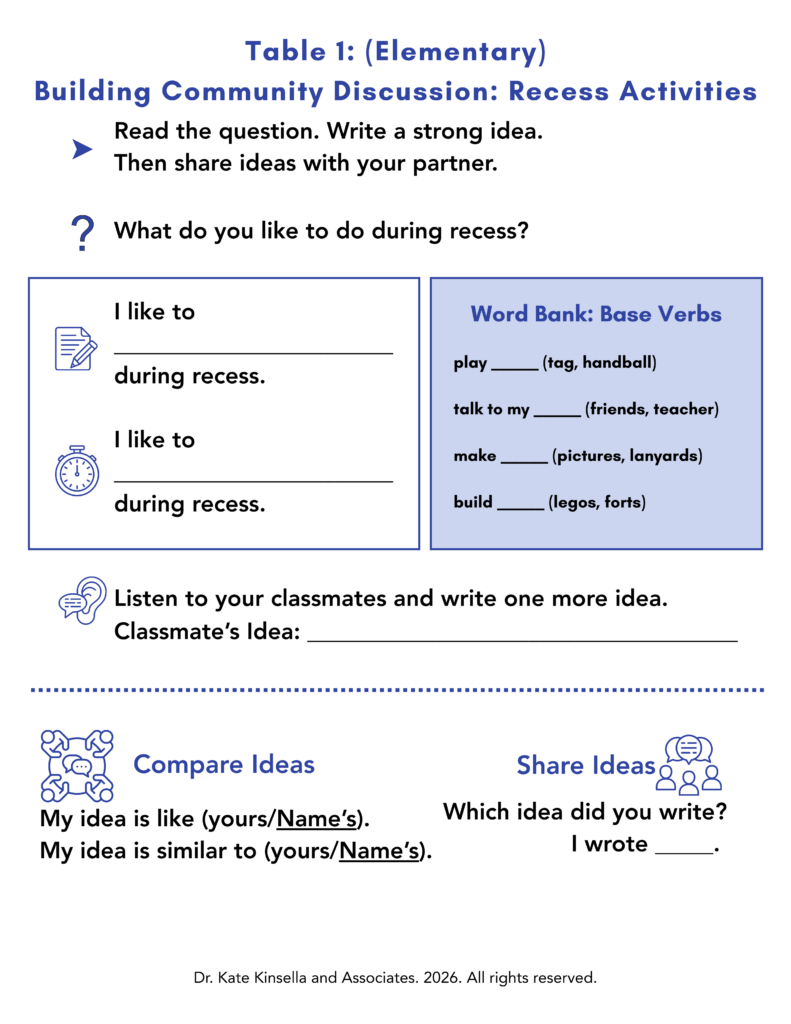
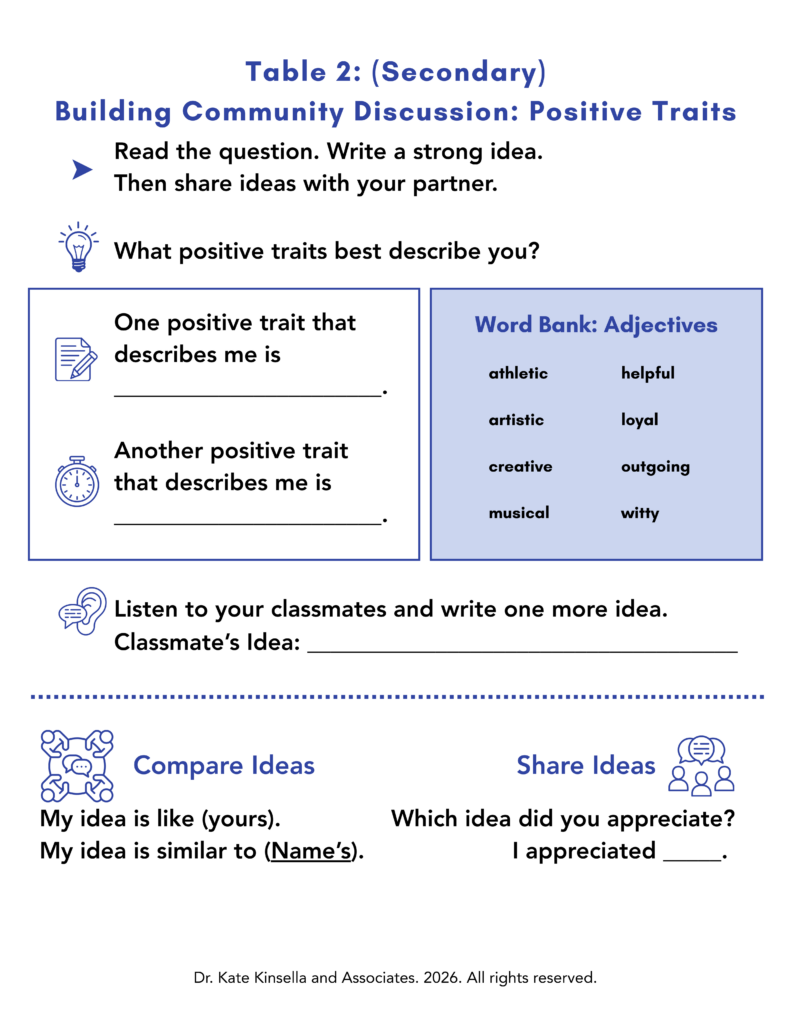
Equipping students with a discussion guide enables them to more successfully navigate the lesson stages and utilize the integrated language tools. A prepared guide such as the exemplars featured in Tables 1 and 2 enables the teacher to maximize time and focus on supporting students through the process. When discussion prompts are provided in adopted curricula, frequently the student-facing lesson does not include the question or any targeted language supports. The teacher may be armed with little more in the Teaching Guide than a suggested prompt to toss out to the classroom stratosphere with guidance to structure a “Turn & Talk.” This ill-advised process leaves our most vulnerable language scholars at a decided disadvantage, relegating engagement to their auditory processing faculties.
An effective prepared guide for introductory community-building discussions should include directions, a discussion prompt, response frame(s), a focused word bank, and active-listening tasks for partner and whole class interactions. Once language learners are familiar with the process, expectations, and use of language scaffolds, they can more easily participate in a curriculum-aligned lesson interaction with only a displayed prompt, response frame, and familiar active-listening task like comparing ideas. The focus of each community-building discussion should be on an engaging and familiar topic that does not require extensive background-building. When English learners are faced with a new instructional process or assignment, the content must be accessible so they can focus on the expectations for learning (Gersten & Baker, 2000). Introducing English learners to expectations for academic discussion with scaffolded community-building lessons increases the odds they will more readily contribute as active speakers and listeners in their core content area coursework (Kinsella & Hancock, 2018; HMH, 2025).
Community-Building Prompts for Elementary Learners
The following prompts for elementary classrooms have been widely used and vetted by district partners. Like the exemplar discussion guide focused on recess activities in Table 1, these prompts and response frames enable young scholars to draw upon familiar experiences while learning how to interact academically.
- What is a snack that you enjoy eating?
A snack that I enjoy eating is __(noun).
- What is your favorite after-school activity?
My favorite after-school activity is __(verb + ing).
- What is one trait you appreciate in a friend?
I appreciate a friend who is __ (adjective).
Community-Building Prompts for Secondary Learners
The following prompts for secondary classrooms have also been widely used and vetted by district partners. Giving teens a chance to discuss something funny, extracurricular, or worthy of complaint lowers their affective filter and promotes active listening.
- What is your favorite summertime activity?
My favorite summertime activity is __ (verb + ing).
- What is a chore you do not enjoy doing?
A chore I do not enjoy doing is __ (verb + ing).
- What is a movie or television show you would recommend to a peer?
A (movie/television show) I would recommend to a peer is __ (proper noun).
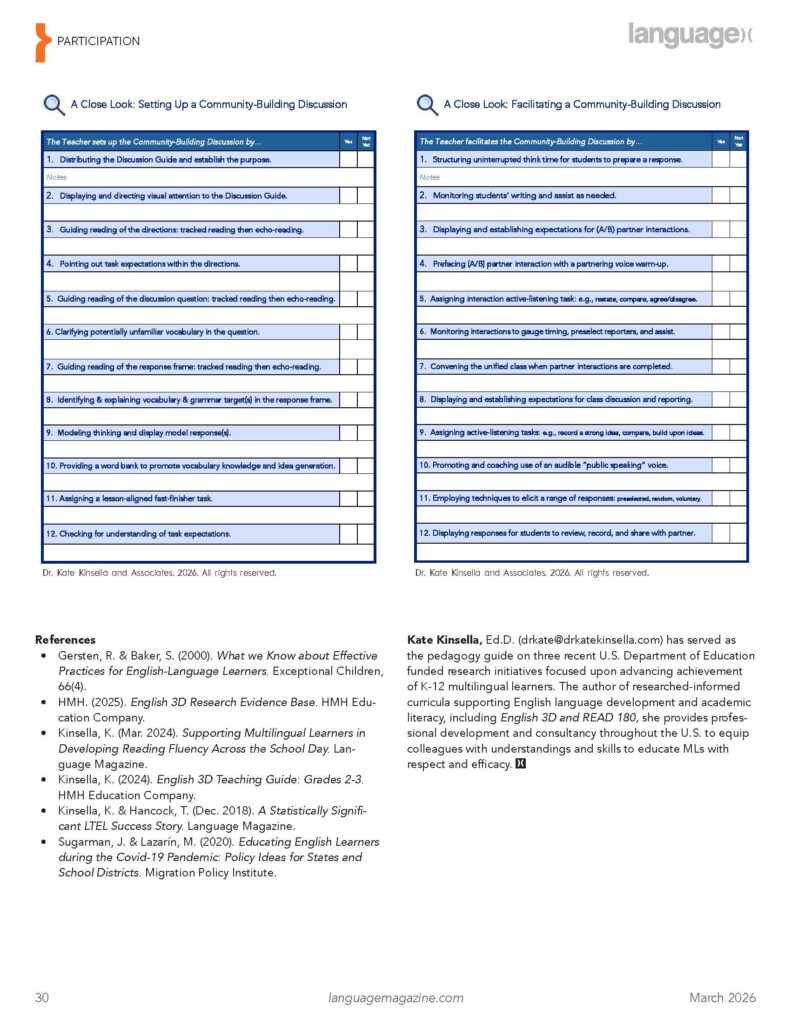
A Close Look: Setting Up a Community-Building Discussion
(Adapted from Kinsella, K. (2024) English 3D Teaching Guide, Grades 2-3. HMH)
The following step-by-step process is gleaned from a decade of Dedicated and Integrated ELD focused research projects, professional development, and technical coaching across grade levels (HMH, 2025; Kinsella, 2018).
- Distribute the discussion guide, then establish the purpose and learning goals.
- As you launch your initial community-building discussion, clarify why you are taking a few days break from your curriculum. Emphasize tandem academic and social goals to help all students feel more comfortable, prepared, and included in lesson discussions. For the next few days, we are going to step away from our curriculum to strengthen our classroom community. We will learn more about each other while practicing how to be an effective partner or group member in important discussions at school and work. My goal is to have every student feel ready and interested in sharing ideas, and I will support you with clear explanations and modeling. We’ll practice asking and answering questions using complete sentences and precise vocabulary. We’ll also learn how to demonstrate that you are listening carefully and respectfully.
- As you proceed with follow-up community-building discussions, make connections to the previous day’s learning, active-listening goals, and the importance of speaking audibly. Yesterday, we learned positive personal traits of our classmates such as being responsible and creative. Today, we’ll discuss similar and different traits we value in a friend. As we exchange ideas, we’ll demonstrate active listening again by restating and comparing ideas, and we’ll make every effort to speak loudly and clearly so our classmates can hear and appreciate what we have to say.
- Display and direct visual attention to the discussion guide.
- Display the guide so that is large enough for every student to easily see. Consider using a document camera to help students warranting more attention, such as newcomers and dually-identified learners, readily follow along during each lesson stage.
- Position yourself so you can gesture to the specific part of the guide you are addressing.
- Call students’ attention to the board or screen using clear and consistent wording: Let’s look at…; Now, let’s focus on…; Let’s all direct our attention to…
- Provide students with a colored card stock bookmark to help them navigate a discussion guide and signal to you that they are in the right place. Place your blue Reading Guide Card under the directions. Now, let’s read the directions together to make sure we all understand what to do.
- When using a document camera, place your Reading Guide Card beneath the focal content to direct attention as you explain and model.
- Guide reading of the discussion directions: tracked reading then echo-reading. (See Kinsella (2024) for detailed guidance on instructional routines for building reading fluency.)
- Direct students’ attention to the discussion directions. Point to the blue arrow, like me. Slide your Reading Guide Card beneath the directions as I have.
- Guide fluent reading of the directions with an initial silent tracked read. Let’s read the directions to understand what we need to do. Follow along silently with your eyes and (finger, pencil, Reading Guide Card) while I read aloud.
- Guide fluent re-reading of the directions with phrase-cued “echo-reading”: I’ll read one phrase at a time and you’ll echo back. Read the question. Echo, please. (Students “echo” the phrase/brief sentence.) Write a strong idea. Then share ideas…with your partner.
- Point out task expectations within the directions.
- Underline key words within the directions and number each discrete task. Let’s underline and number each of our tasks. First, I’ll underline the direction verb “read.” Our first task is to read the question. Second, I’ll underline the verb “write.” Our second task is to write a strong idea. Next, I’ll underline the verb “share.” Our third task is to share ideas with our partner. So, we have three important tasks in today’s lesson discussion.
- Guide reading of the discussion question: tracked reading then echo-reading.
- Direct students’ attention to the discussion question/prompt. Point to the blue question mark, like me. Slide your Reading Guide Card beneath the question as I have.
- Guide fluent reading of the discussion question/prompt. Echo the question, please: What do you…like to do…during recess? One more time with larger phrases: What do you like to do…during recess?
- Clarify potentially unfamiliar vocabulary in the question.
- Underline and direct attention to words that may warrant clarification for some learners. Notice this word: during. Echo, please. When we say during recess, it means at recess time. It doesn’t mean where; it means when, at the time we have recess.
- Guide reading of the response frame: tracked reading then echo-reading.
- Direct students’ attention to the response frame. Point to the blue pencil, like me. Slide your Reading Guide Card beneath the frame as I have.
- Guide fluent reading of the response frame. Echo the frame, please. We’ll say “blank” where there is a blank to add our idea. I like to blank…during recess. Once again.
- Identify and explain vocabulary and grammar target(s) in the response frame.
- Point to and underline or highlight repeated words in the frame from the question.
Notice that there are repeated words in the question and frame: like, to, during, recess. When you answer a question either speaking or writing on a test or assignment, it is always a good idea to repeat words in your response. This makes your response sound complete and academic.
- Point out any grammar target in the frame. Notice the word “to.” Let’s all circle this word in our frame. The preposition “to” has little meaning, but it signals to me that I need a verb, an action word right after. And the verb needs to be a base verb, one with no ending like -s, -ed, or -ing. In the blank, we will all write a strong base verb to indicate what we like to do during recess.
- Model thinking and display model response(s).
- Model aloud your thinking process. I know that my students like to do many things during recess. For example, I see that some like to talk to their friends and others like to play games. I’ll write talk to my friends.
- Structure verbal rehearsal with the frame using your displayed model response. Let’s get comfortable using the frame with my response. Echo, please: I like to…talk to my friends… during recess. One more time with larger phrases: I like to talk to my friends…during recess.
- Provide a word bank to promote vocabulary knowledge and idea generation.
- Display and direct attention to a prepared word bank (on guide or screen/board). I have prepared a word bank with strong base verbs and nouns that can help you write a strong response. Point to the blue word bank on your discussion guide. Put your pencil down and look at the bank on the blue sticky note I have displayed on the screen.
- Echo-read each displayed word choice and clarify any potentially unfamiliar meanings.
- Point out that the word bank offers choices, but students may write any idea that they prefer. They are not limited to these word choices. You may use any of these strong verbs or nouns if you wish, but if you prefer to do something else during recess, please do write that idea.
- Offer to assist students with spelling or coming up with an idea if they are having difficulties. Pencils up if I may help you write or think of the right word to put in the blank. I will come help you.
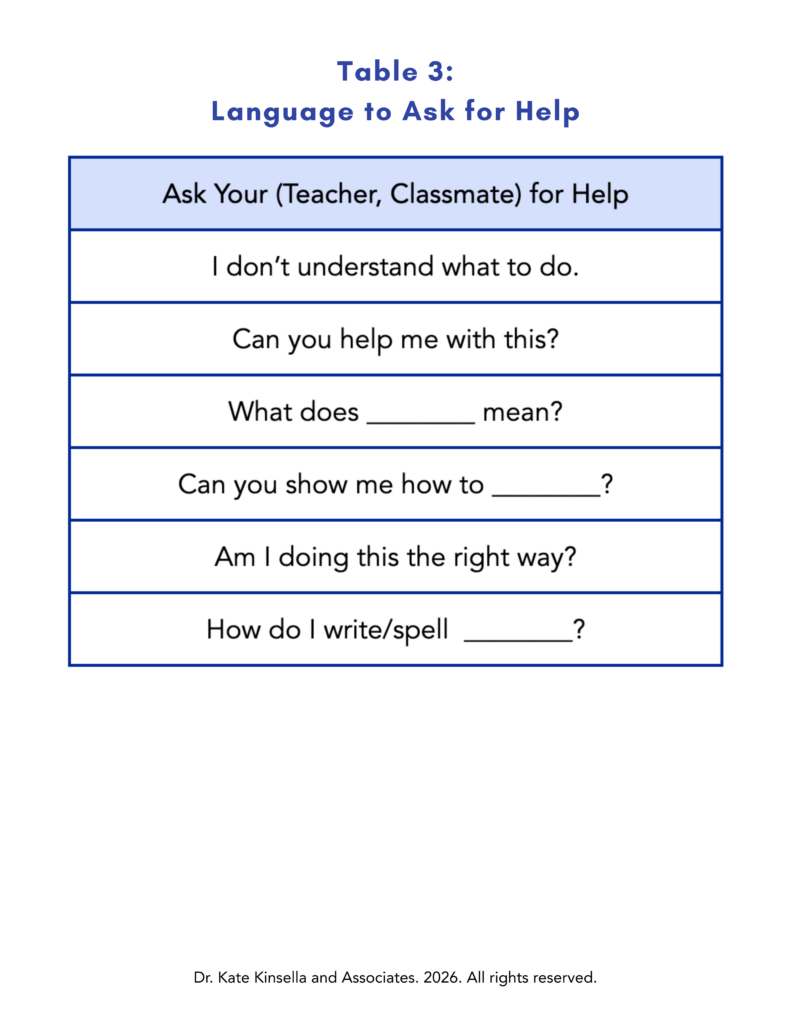
- Display Language to Ask for Help (See Table 3) and point out appropriate requests for the lesson demands, for example, explaining a specific word meaning or showing how to write an idea.
- Assign a lesson-aligned fast-finisher task.
- Before cueing students to write, assign an appropriate fast-finisher task. For example, if you have provided one frame, direct students to write a second sentence using the same frame but adding a new idea. If you provide an additional frame, direct fast-finishers to write a second sentence with the new frame. Consider adding a stopwatch icon before the fast-finisher frame to cue it is the follow-up task. If you have finished writing a strong sentence, and I have not called time, please write a second sentence with our fast-finisher frame, adding a new idea.
- Check for understanding of task expectations.
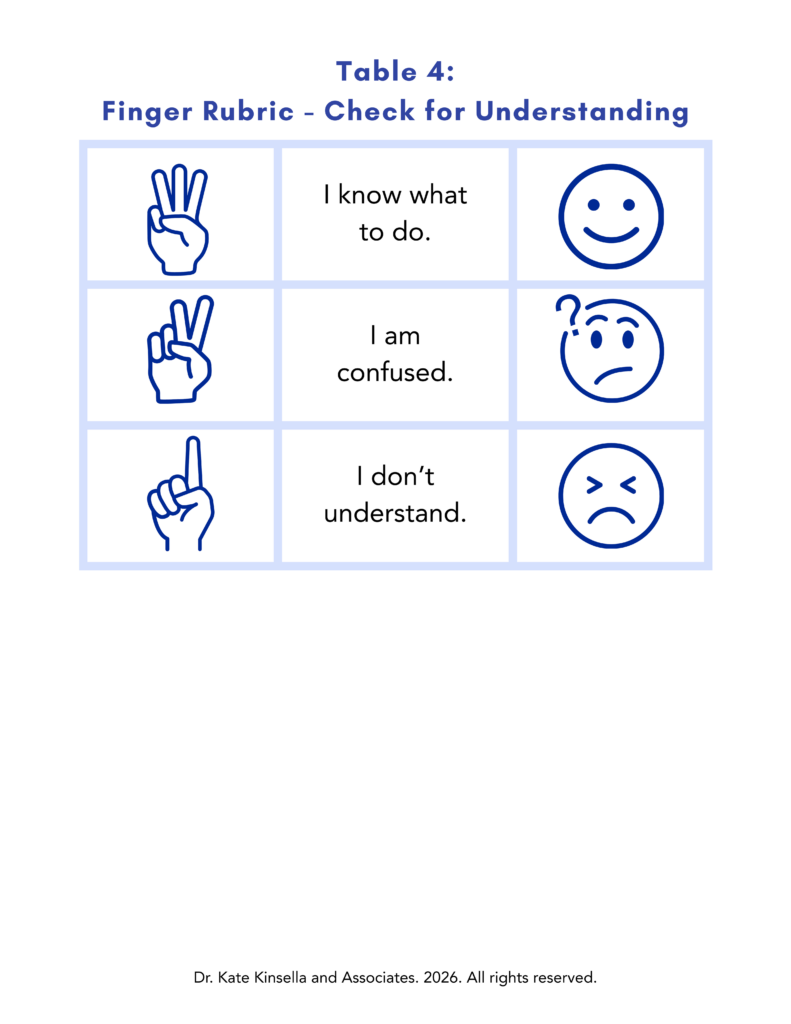
- Use an efficient and familiar method to check whether students understand what you expect them to do. Consider a nonthreatening nonverbal gesture to support newcomers and dually-identified learners, such as a finger rubric, displayed discretely beneath their chin, not with a raised hand.
- Display a poster prominently with a finger rubric or icons representing levels of understanding. (See Table 4: Finger Rubric.)
- Point to the poster or slide as you cue use of a finger rubric. Show me with your fingers beneath your chin how well you understand what to do: 3) I understand; 2) I am a little confused; 1) I don’t understand. It looks like you are all ready to write your sentences.
A Close Look: Facilitating a Community-Building Discussion
(Adapted from Kinsella, K. (2024) English 3D Teaching Guide, Grades 2-3. HMH)
- Structure uninterrupted think time for students to prepare a response.
- As students think and begin writing, refrain from disrupting their thought processes by repeating directions, reprimanding off task students, or counting down minutes left. Once I have given the signal to begin, I will be quiet so you can think and write. I will circulate to help you and review your work.
- Monitor students’ writing and assist as needed.
- Circulate strategically to assist students as needed, gauge the amount of time needed for completion, and identify common and original ideas.
- Preselect one or two students discretely to be the first whole-class discussion reporters. Let students know that this is a new practice you will be using to get the class discussion off to a positive start and that each of them will have the opportunity to be your discussion helper. (Name), I would like to call on your first to share your strong idea during our class discussion. Read it over carefully so you are ready to contribute.
- Display and establish expectations for (A/B) partner interactions.
- Assign letters (A/B) for partners to easily comprehend who should speak first. This reduces the down time and anxiety when students are reluctant to initiate interaction. Rotate which letter is cued to begin an interaction.
- For younger learners, place a small A or B on their desk or table space. For intermediate and secondary grades, place an 8” x 11” colored card stock A on one wall and B on another, or use rows or proximity to items (clock, flag) to cue A/B partner roles.
- Ask students to confirm their (A/B) partner letter before setting up a partner task. So, where are my partner As? Raise your hands. Partner Bs?
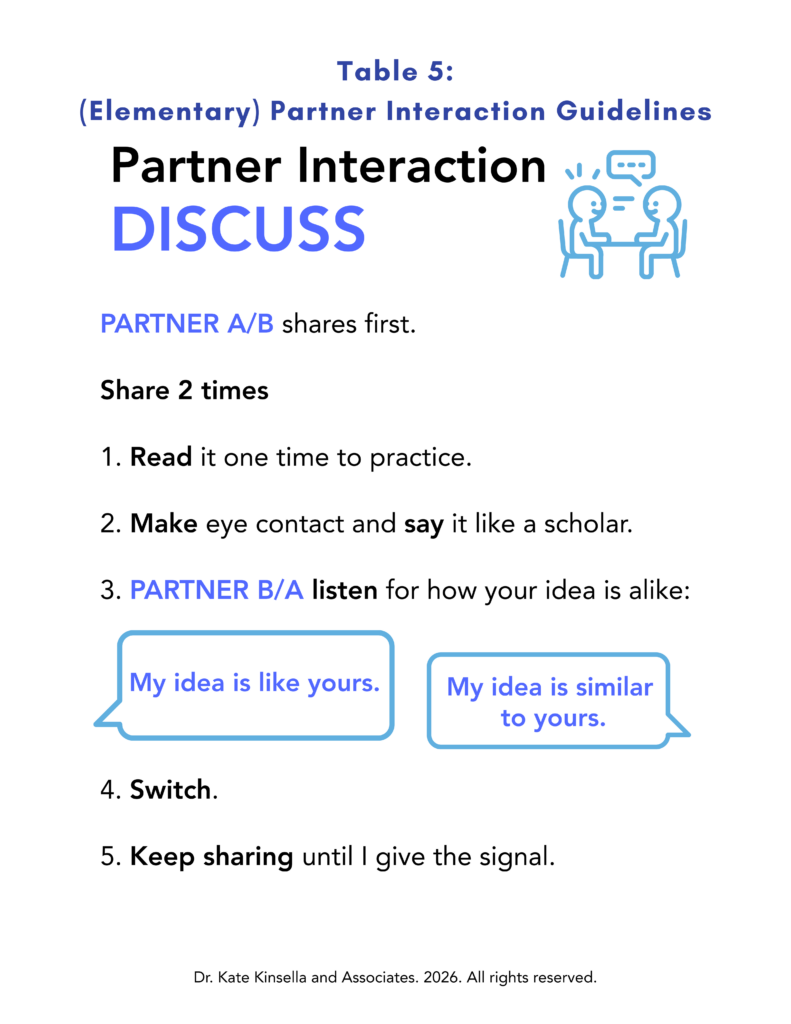
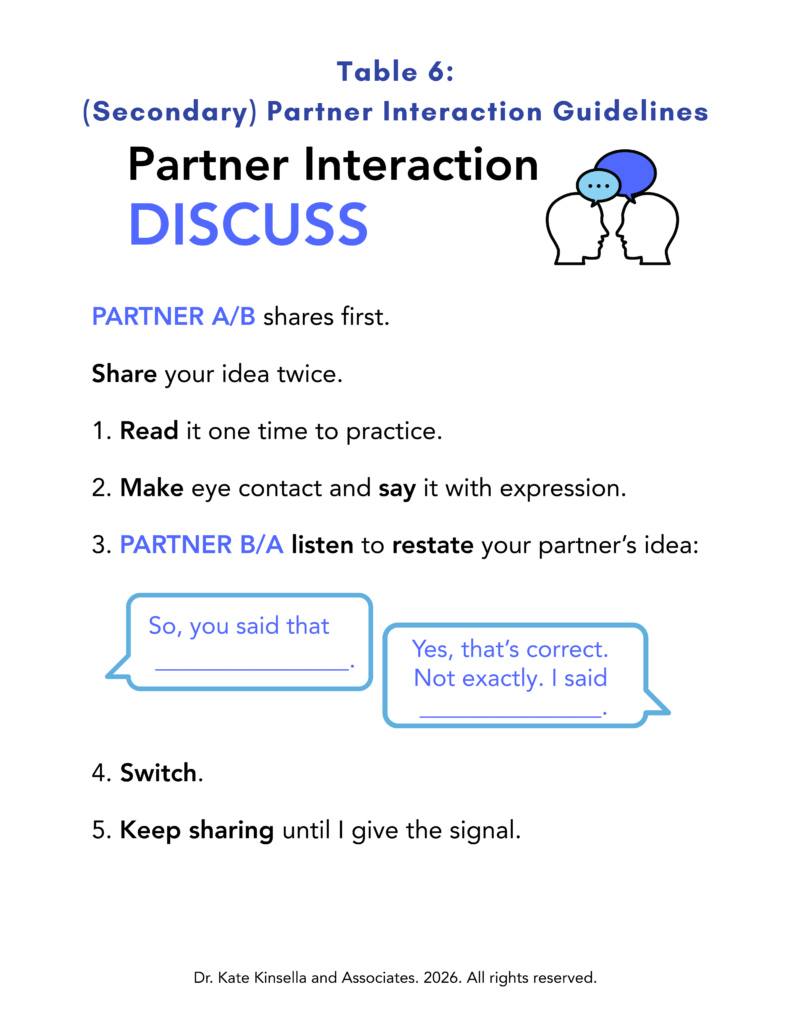
- Display directions for partner interactions. (See Tables 5 and 6 for examples.) Language learners will be challenged to process a steady stream of verbal directions.
- Direct students’ attention to the directions and clarify expectations for speaking and listening. As we always do, you will share your idea twice: once to practice and again with expression. This will help you feel ready to contribute to our class discussion and give your partner two times to listen carefully and remember your idea.
- Preface (A/B) partner interaction with a partnering voice warm up.
- Emphasize the importance of speaking loudly, clearly, and slowly enough for their partner to listen carefully and remember.
- Structure verbal rehearsal with a model response. Let’s warm up our partnering voices by echo-reading my model response twice: once to practice and again with expression.
- Assign a partner interaction active-listening task.
- Emphasize the importance of active listening during partner interactions at school, at work, and in clubs and community organizations.
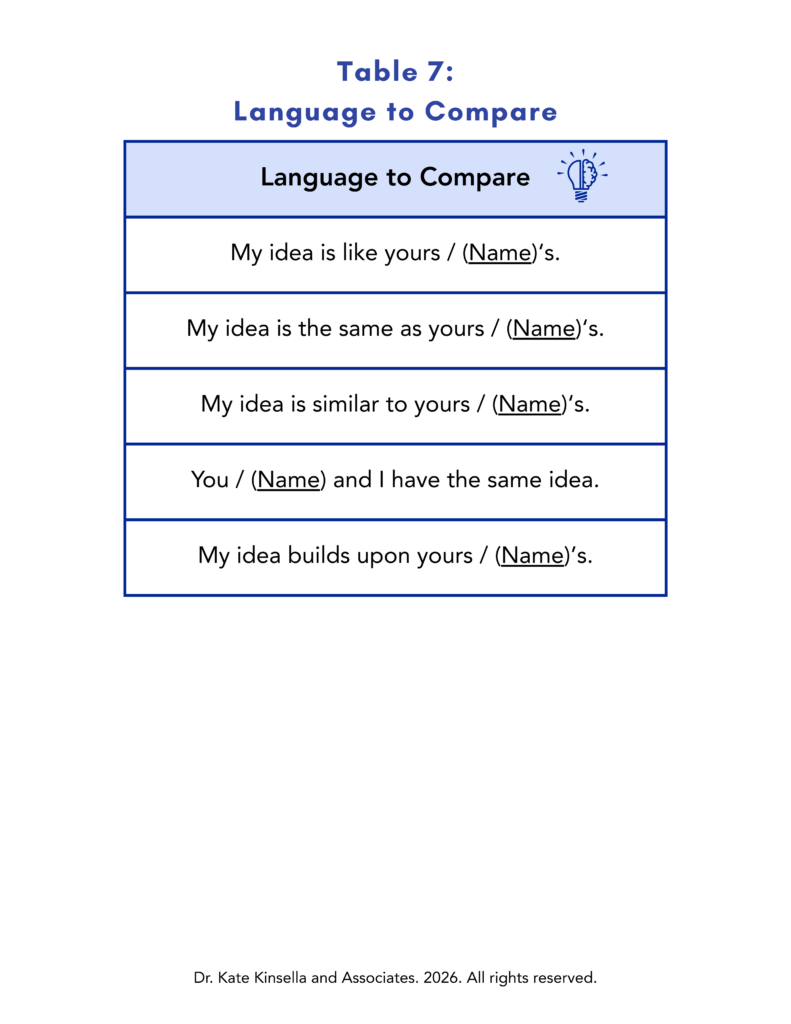
- Initially assign manageable tasks with developmentally appropriate expressions. Start with restating a partner’s idea and progress to comparing and building upon ideas. Introduce an easier expression for comparing first: My idea is like yours. As students internalize this expression, progress to another.
- Display language for active listening prominently for easy reference during any lesson interactions.
- Monitor interactions to gauge timing, preselect initial reporters, and assist as needed.
- Circulate strategically to observe partner interactions with a range of proficiency. Begin with partners who are representative of the average proficiency level in the class in terms of language, literacy, and content knowledge. Proceed to a duo with more advanced and another with more exceptional needs.
- Preselect 1-2 students with more representative responses to launch the discussion. This leaves likeminded peers feeling validated and eliminates the awkward silent and pressure as a teacher awaits a voluntary response.
- When preselecting a student, speak softly and efficiently to minimize disruption. You will be our first reporter with this strong example.
- Encourage a student with a strong response to voluntarily contribute when you open the class discussion to volunteers. I would appreciate it if you volunteered your strong response. I know your classmates will appreciate hearing from you.
- Convene the unified group/class when partner interactions are completed.
- As partners conclude their interactions, use a familiar phrase or cue to convene the unified class/group.
- Acknowledge their productive partner interactions. I appreciated how you all shared your responses twice and very clearly so your partner could listen actively and restate your idea. I heard some popular or similar ideas and some unique or different ideas.
- Establish speaking and listening expectations for class discussion.
- Encourage use of a “public-speaking voice”: three times louder than your partnering voice with pauses and expression so your classmates can hear and remember your idea.
- Direct attention to specific expectations for contributing or listening, for example, comparing and building upon ideas after classmates contribute. (See Table 7 for examples of language to compare or build upon ideas.)
- Assign a small and manageable active-listening notetaking task. When using a Community-Building Discussion Guide, point out the icon of an ear and emphasize that they should listen carefully for an interesting idea to record after the discussion. As your classmates contribute ideas, listen for an interesting idea to record.
- Employ techniques to elicit diverse responses: preselected, student-selected, voluntary.
- Refrain from relying upon habitual volunteers or cold calling on reticent contributors.
- Follow a reliable sequence of strategies for eliciting responses after familiarizing students with the protocols for each: 1) preselected; 2) student-selected; 3) voluntary.
- Refrain from using random-selection devices such as digital selectors than can easily make apprehensive contributors feel anxious and preoccupied with being called upon rather than authentically engaged in listening and learning.
- Promote and coach use of an audible “public speaking” voice.
- Introduce the concept of a “public speaking voice” for large group or whole-class discussions: holding your lesson material, looking up, and projecting your voice so the classmate furthest away can hear your contributions.
- With secondary students, make connections to school and workplace success. In college and workplace settings, you must speak up loudly and clearly enough in classes or meeting for everyone to hear you. I will politely encourage you to project your voice so you are ready for high school, college, and workplace listening expectations.
- If a student contributes too softly and inaudibly, politely request stronger verbal delivery. Thank you. This time speak loudly enough so your classmates in the back of the room can hear your idea. Much better. I appreciate your thoughtful contribution.
- Employ techniques to elicit a range of responses: preselected, random, voluntary.
- Rather than rely upon cold-calling student contributors or relying on habitual volunteers, use more inclusive practices to elicit a range of responses.
- Begin with a preselected initial contributor, proceed to student-selected contributors, and conclude with authentic and encouraged volunteers.
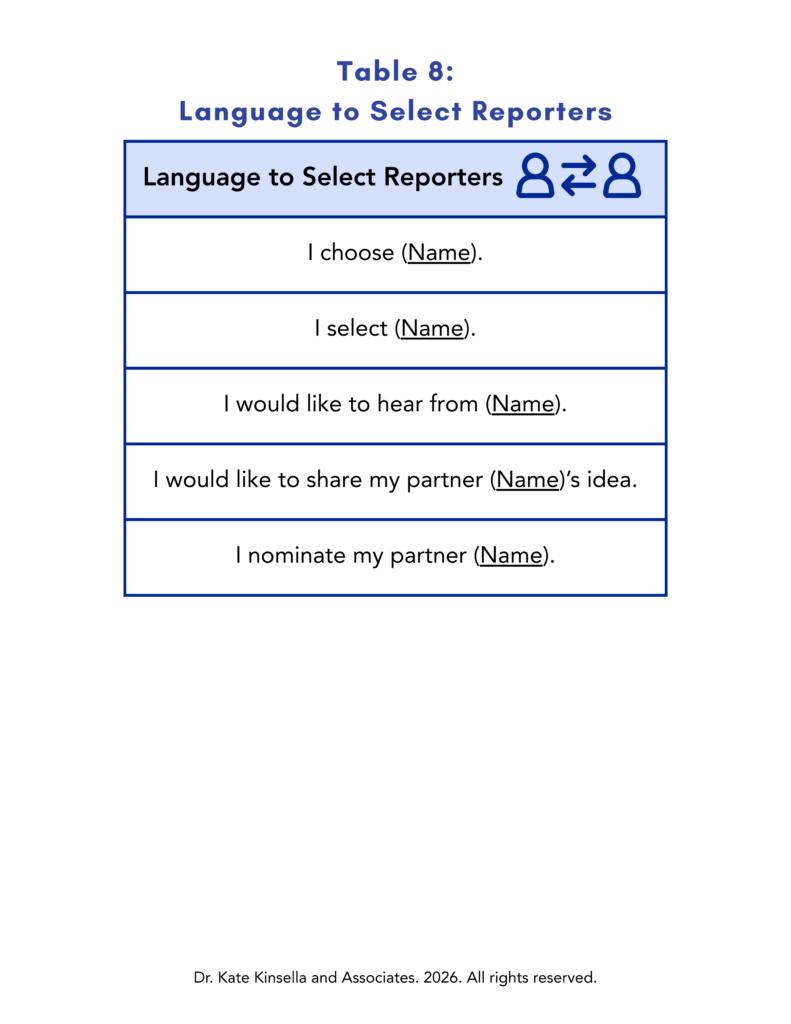
- Display Language to Select Reporters (See Table 8). After launching the class discussion with a couple preselected contributors, ask the second student to select a classmate from another table/row/area of the room to be the next reporter. Assign an entry-level expression such as “I select (Name)” and proceed to more advanced expressions once students are familiar with the process.
- Conclude the discussion by requesting a couple volunteers, whether authentic or requested. While monitoring students writing and partner interactions, ask one or two students with strong responses to kindly volunteer as you wrap up the discussion. We have time for a few more examples. I would appreciate one from the back and front of the room. Thank you, (Name), we welcome your contribution.
- Display responses for students to review, record, and share with a partner.
- When using a document camera, wait to display recorded contributions until after you have concluded the discussion. In this way, students can more easily focus on listening to their peers and not be preoccupied with reading and/or copying what you are recording.
- Direct students’ attention to the displayed list of recorded ideas. Let’s put our pencils down and review the strong set of ideas from our discussion. I’ll read each adjective naming a positive trait and you echo-read: loyal…artistic…
- Cue students to review the list and add one or two ideas to their note-taking guide.
- Structure a final (A/B) partner interaction, providing an opportunity for peers to share ideas they appreciated from the discussion. Assign an appropriate question and answer frame: Which idea did you add? I added __. Which idea did you appreciate? I appreciated __.
- When using a community-building discussion guide like the exemplars in Table 1 and 2, direct students’ attention to the Language to Share Ideas and rehearse prior to cueing the partner exchange. You have each recorded an idea that caught your attention during our discussion. Let’s practice asking and answering the question for our final partner interaction with the idea I selected: reliable.
- Cue (A/B) partner to begin the exchange of ideas.
- After the partner interaction, call on a few ideas to answer the question: (Name), which idea did you appreciate? Provide brief, affirming feedback. You are in good company. Many of your classmates also appreciated that positive personal trait, athletic.
Concluding Thoughts
Pairing or grouping emergent bilinguals for productive lesson interactions clearly necessitates more than a modified seating arrangement and an invitation to talk. The multi-step instructional routine I have shared for orchestrating introductory community-building discussions has a proven track record of improving student engagement and learning in linguistically diverse classrooms. The technical coaching tools I have provided were developed to help teachers be more mindful of their setup and facilitation of lesson discussions including language learners at earlier stages of proficiency. These non-evaluative technical coaching tools are equally useful for instructional coaches as they guide viewing of a demonstration video, co-teach, or observe a lesson demonstration. Across the school day, multilingual learners in all settings should be flexing their language muscles and listening attentively during essential lesson interactions while feeling supported and recognized.
References
•Gersten, R. & Baker, S. (2000). What we Know about Effective Practices for English-Language Learners. Exceptional Children, 66(4).
•HMH. (2025). English 3D Research Evidence Base. HMH Education Company.
•Kinsella, K. (Mar. 2024). Supporting Multilingual Learners in Developing Reading Fluency Across the School Day. Language Magazine.
•Kinsella, K.(2024).English 3D Teaching Guide: Grades 2-3.HMH.
•Kinsella, K. & Hancock, T. (Dec. 2018). A Statistically Significant LTEL Success Story. Language Magazine.
•Sugarman, J. & Lazarín, M. (2020). Educating English Learners during the Covid-19 Pandemic: Policy Ideas for States and School Districts. Migration Policy Institute.
Kate Kinsella, Ed.D. ([email protected]) has served as the pedagogy guide on three recent U.S. Department of Education funded research initiatives focused upon advancing achievement of K-12 multilingual learners. The author of researched-informed curricula supporting English language development and academic literacy, including English 3D and READ 180, she provides professional development and consultancy throughout the U.S. to equip colleagues with understandings and skills to educate MLs with respect and efficacy.